

The Death of Organic Reach: What Musk’s AI Era Means for MedTech Brand Pages on X
The Algorithm Shift, Part 2: The evolution of MedTech Marketing on Twitter (X)
Editor's Note: This is Part 2 of a 3-part series exploring the evolution of social media platforms and their implications for MedTech Marketing. See Part 1 (Facebook Evolution)
Article Summary
The Problem: The Twitter algorithm has changed completely since the early days. What worked for brand growth in the past simply does not work today in Musk’s AI era
The Solution: Brands must understand how today’s X functions to succeed, including embracing a paid subscription model.
The MedTech Reality: If you aren’t willing to pay for subscription, your brand page will act like a billboard of info with no organic reach. But if you do participate, you need to be aware of compliance risks.
The Takeaway: To succeed on modern X, MedTech brands must be aware of compliance risks, must allocate budget even for “organic” presence and re-evaluate engagement strategy to stay relevant.
Evolution of Twitter from the early days to Today’s X
Twitter was founded in 2006. I started using Twitter around 2010, but I wasn’t actively building strategies for Twitter for business until 2017. Watching its algorithmic transformation over the last decade has completely reshaped how marketers navigate digital marketing in highly regulated spaces.
2006- 2014: Chronological Era
When Twitter first launched, it didn’t rely on a complex machine learning model to rank content. Like the early days of Facebook and LinkedIn, it delivered a reverse-chronological feed, i.e. users saw every single post from accounts they followed, organized by the time of posting.
If you log in at 5pm to check your Twitter feed, you could scroll down all the way to 8am of the same day to see what you missed – a massive amount of content, which could keep you on the platform for hours. However, people don’t have all day to scroll through their Twitter feed, therefore, a tweet “lived” only for 15-20 minutes until it was no longer “visible” or “mattered” as users moved on (either closed out their Twitter feed or looked at the freshest content on top of their feed).
This presented a big problem for organic visibility. The more accounts a user followed, the faster your feed moved, making it difficult for brands to get noticed in the sheer volume of posts.
What did this mean for MedTech brands?
For MedTech brands, this dictated their approach to social media strategy. You had to time your tweets precisely when HCPs or patients (in DTC marketing) where online; otherwise, they missed your tweet. And that’s when two things originated:
1. The obsession with finding the perfect “time to post”
2. Posting the same tweet multiple times a day to maximize exposure
I remember I was at a presentation by Guy Kawasaki, the chief evangelist of Canva, where he shared a case study proving that cross-scheduling the same message three times a day boosted overall reach without cannibalizing engagement. When an audience member asked, "What if the same user sees the exact same post all three times?" Kawasaki replied, "Then they have too much free time on their hands!" The underlying message was that repetition will not trigger users to unfollow accounts. Instead, in a fast-moving chronological world, it was a necessary mechanism for message retention.
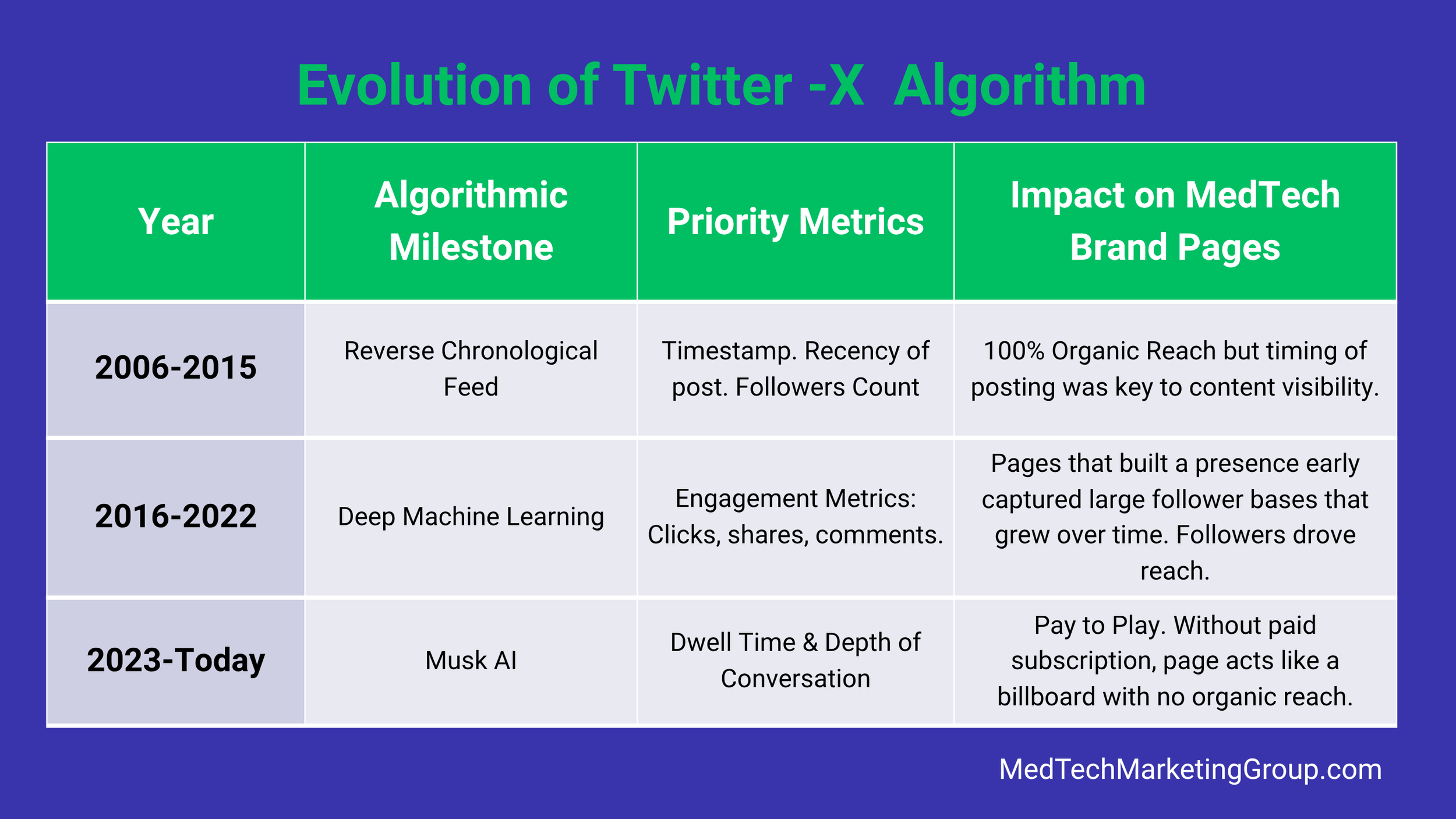
📊 [ ] Expand Data Table: Evolution of Twitter / X for MedTech Marketing
Year: 2006–2014
- Algorithmic Milestone: Reverse Chronological Feed
- Priority Metrics: Recency of post
- Impact on MedTech Brand Pages: 100% Organic Reach but timing posting was key to content visibiltiy
Year: 2016–2022
- Algorithmic Milestone: Deep Machine Learning
- Priority Metrics: Click, shares, comments
- Impact on MedTech Brand Pages: Pages that built a presence early captured large follower bases that grew over time. Followers drove reach.
Year: 2023–Today
- Algorithmic Milestone: The Pay-to-Play Split
- Priority Metrics: Dwell Time & Depth of Conversation
- Impact on MedTech Brand Pages: Pay to Play. Without paid subscription, page acts like a billboard with no organic reach.
2016 - 2022 Relevance Algorithm
By 2016, Twitter underwent a major change, entering the era of deep machine learning – just like Meta and LinkedIn. Twitter introduced a relevance-based model to rank your content. These machine learning algorithms evaluated how users engaged on the platform – what posts they liked, shared, commented. This allowed the platform to organize content into a manageable feed while serving personalized, high-interest updates to each user’s unique timeline.
This change was a first fundamental shift in the platform. Its model changed from when you posted to how users reacted. It meant that you no longer would see the posts of all the users you followed. For brands, it meant that 100% organic visibility was going away.
Twitter displayed content based on likes and retweets, and if users engaged with your post within 30-60 min window, it signaled to the algorithm to show content in more feeds of their connections, which contributed to “virality” of your content. Tweets that garnered immediate engagement—likes, comments, and retweets—were algorithmically pushed to the top of newsfeeds. This is exactly what Facebook undergone in 2011-2013 with predictive machine learning models.
Case In Point: A Strategy for High Engagement
In 2017, as a digital product manager at a global medical device company, I was involved in the creation of content strategy for our first official corporate presence on Twitter. A year later, I was leading Twitter content strategy for intravascular imaging technology and went on to develop one of the most engaging campaigns. It was ultimately recognized internally as the top-performing organic campaign.
I introduced storytelling via “threads” – when you build a tweet upon a tweet – to help better engage with HCPs. And they did engage – they liked, shared and even commented on the content! It was a huge milestone back then to get HCP to comment on your content. Campaign exceeded industry and internal benchmarks multiples higher than standard baseline averages.
Why did it work so well?
Highly engaging content meets the relevance algorithm
The answer is two-fold. First, good quality content is key to building audience and driving engagement. Second, understanding how the algorithm works. The campaign achieved both goals: HCPs found the content highly valuable, and their active comments and likes triggered the platform’s algorithm to push the posts directly into the feeds of their extended professional networks.
This also aligned with another shift on the platform – emergence of #CardioTwitter.
Around 2017 and 2018, interventional cardiologists (ICs) started building their accounts on Twitter under the #CardioTwitter hashtag. ICs realized they could use Twitter’s real-time, platform to share live cases, get advice from other HCPs and also share lessons learned from their cases to expand medical education.
Compliance Risk for MedTech Brands on Twitter
Despite this developing digital ecosystem among HCPs, very few MedTech brands capitalized on it early. Most corporate accounts were dormant: some had just an account name, but didn’t post while others weren’t even on Twitter. Medical device marketing is a highly regulated, and legal teams were “mindful” of the compliance risks. Fast forward to today, and social media is a default marketing channel for any medical device brand because markter have laid the groundwork in the previous years.
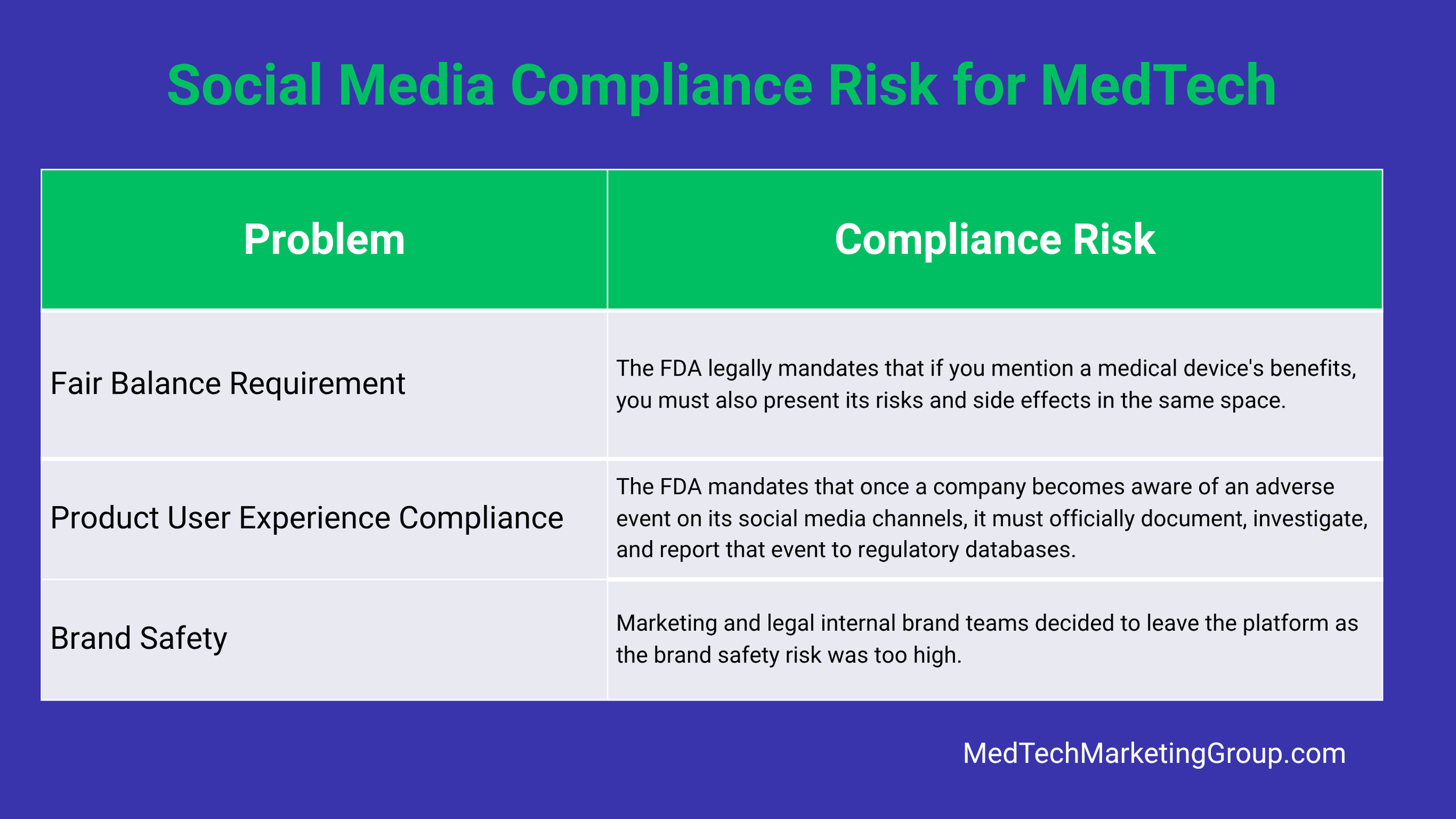
Problem 1: Fair Balance Requirement
The FDA legally mandates that if you mention a medical device's benefits, you must also present its risks and side effects in the same space, known as FDA Fair Balance mandate. If a MedTech brand fails to include an ISI link in a social media post highlighting a device's benefits, it violates this mandate, which means the brand is breaking federal law and exposes the company to regulatory warning letters at the minimum.
In the beginning, Twitter had a strict 140-character limit. This meant that brand pages had to get very creative with post copy to add a link to Important Safety Information (ISI). You also couldn’t split that into multiple tweets - one tweet text copy, and the other tweet ISI. The few medical device companies that successfully navigated these legal guardrails gained a huge first-mover advantage.
How has this requirement changed?
At the end of 2017, Twitter doubled its character limit to 280 characters. This allowed brands to create longer posts and have more room to add ISI callouts.
Today, X has a 280 character limit for unpaid subscriptions. Paid subscriptions have a cap of 25,000 charters per post, which means you have absolutely enough room to add all disclosures you need.
Takeaway?
While adding ISI to your X posts matters the same way it mattered 10 years ago, the difference is that brands have more characters to do so which makes copywriting easier.
Problem 2: Product User Experience Compliance
In the early days, corporate pages mostly pushed information out to their followers. However, as the platform evolved, user behavior shifted. Patients and physicians began using these brand pages to complain about hospital services, procedures, medical staff, or devices that malfunctioned or caused side effects. For MedTech companies, this shift introduced severe risks because brands are legally responsible for addressing these user experience claims through Adverse Event Reporting. (This issue was applicable to Facebook as well).
While a public complaint is usually a public relations issue in most industries, it represents a legal liability in MedTech. Companies must address these complaints within a strict 24--48-hour window. The FDA mandates that once a company becomes aware of an adverse event on its social media channels, it must officially document, investigate, and report that event to regulatory databases. (In fact, anyone working in the MedTech industry must complete mandatory compliance training multiple times a year, so as a PM or Marketing Manager you are trained on this - you can’t say “I didn’t know”).
Consequently, monitoring these channels became a costly, 24/7 responsibility for internal PR and social media teams. Staff had to constantly review comments and initiate formal compliance responses, regardless of whether a notification arrived late at night, over the weekend, or during personal hours.
The Consequences of failure to report adverse events
What if a brand fails to report and investigate all of these adverse events? Failing to track, investigate, and report these social media adverse events carries severe legal consequences:
Revocation of Regulatory Authorization: Failing to report product safety issues violates federal law. The FDA can revoke a product’s 510(k) clearance or Premarket Approval (PMA), which immediately makes it illegal to sell the device in the United States.
FDA Warning Letters: Prior to pulling a product from the market, the FDA will issue warning letters and publish them on its official website. This public disclosure can damage a brand overnight, destroying market trust, causing hospitals to cancel active purchase orders, and triggering a drop in stock price.
Product Recalls: If multiple users report the same issues (for example, a patient complains of continuous chest pain after a device placement) , the FDA can mandate a Class I product recall. For global corporations, this requires removing every single unit from shelves worldwide, resulting in millions of dollars in lost revenue and logistical expenses.
Does this still matter today on X?
The same compliance rules apply today as they applied 10 years ago. The biggest difference is the medical device companies had 10+ years to learn and build their own organizational “Social Media Playbooks” which outline governance models vs the early adopters who had to learn and adopt on the go, and sometimes suffer consequences.
Takeaway?
Launching a corporate social media page is far more complex than just setting up a digital profile. Organizations must establish a strict governance model which outlines how to monitor interactions and have clear escalation and response protocols, in additional to content creation, sharing, approving and distribution.
Problem 3: Brand Safety
When Musk acquired Twitter, immediate changes hit the channel. As someone who has used the platform for over ten years, the shift was obvious in the amount of unmoderated content, untargeted, irrelevant ads and spam. To make it worse, AI algorithm started placing corporate posts and paid ads right next to unmoderated and/or controversial user content. This created a brand safety risk for healthcare and MedTech brands. Marketing and legal teams decided to leave the platform to avoid compromising the brand.
There was a large exodus of these companies from the platform - at first, many paused paid ads, and some paused even organic posting, while others completely left the platform.
Why brand safety is so important?
Brand safety is critical for MedTech and healthcare companies because of the life-saving technologies and devices they produce. In this industry, trust, clinical evidence, and corporate reputation are everything. If a brand's posts or advertisements appear next to highly questionable content, it immediately damages user trust.
Ultimately, this can make healthcare professionals or patients look for alternative products simply because they do not want to be associated with that reputational risk.
Elon Musk Era: 2023 - Today
When Elon Musk acquired Twitter at the end of 2022, it has shattered the entire architectural foundation. The transformation went far deeper than dropping the iconic bird logo for X; it fundamentally changed organic discovery, shifting from an engagement-based platform to a heavily monetized, creator-driven AI model.
How does today’s X algorithm work?
Pay-to-Play & Premium Membership
While the platform remains free to use, you aren’t getting what you used to for the membership because the model is build to monetize.
When you create an account or have an existing account, you are asked to Get Verified. This basically means you are asked to purchase a membership (subscription) to X - Basic or or Premium. Based on the type of subscription, you experience the platform differently - from being “visible” to seeing more or less ads, having access to analytics or zero analytics, boosted replies, access to Grok AI, etc.
X Premium (Basic/Growth): Tailored for individual creators to secure the blue checkmark and baseline algorithmic ranking.
Verified Organizations: Designed for enterprises and brands. Securing the gold checkmark requires a substantial monthly financial commitment. If a corporation refuses to pay for this verified status, the algorithm systematically suppresses their posts from public feeds.
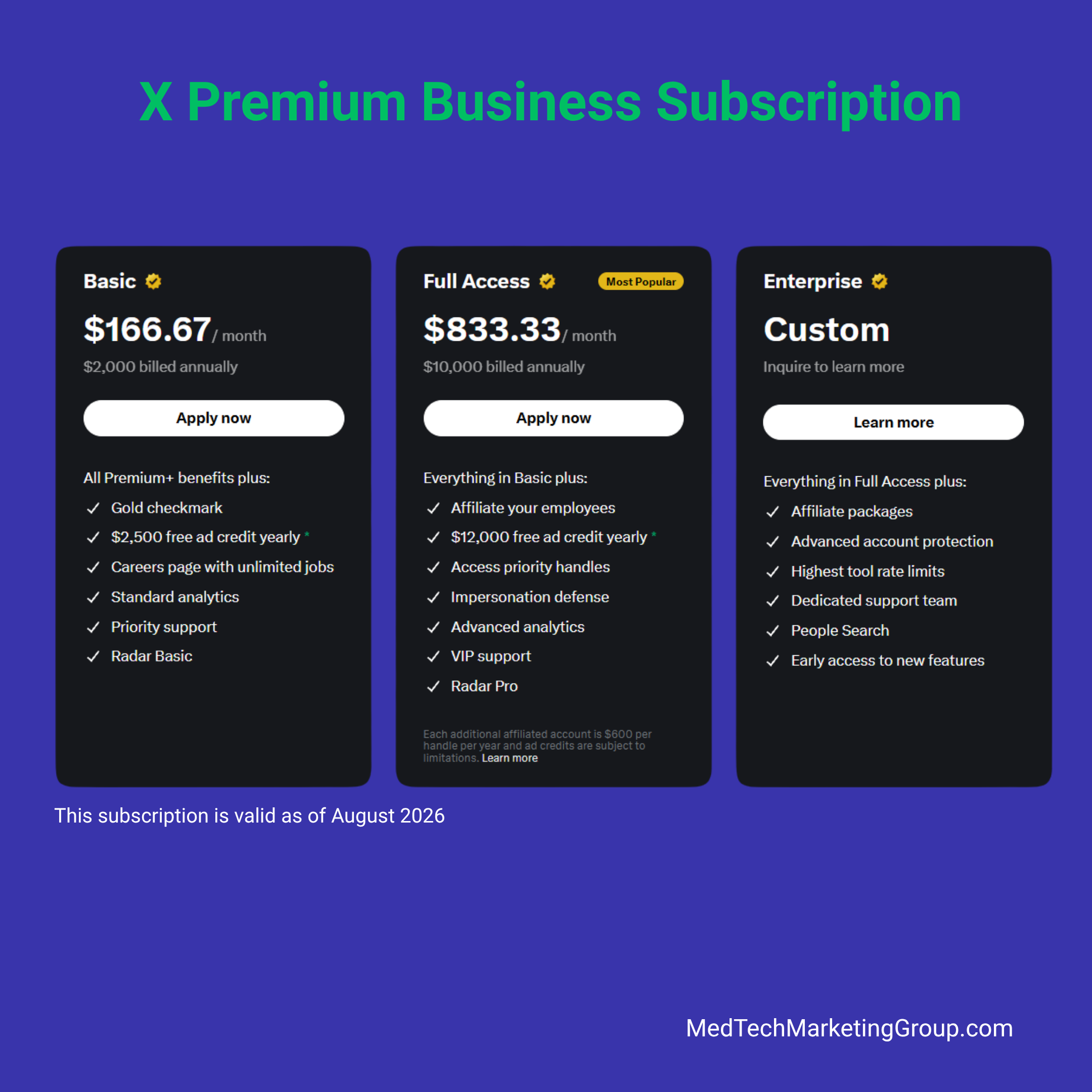
What if you or your brand page doesn’t “Get Verified”?
The algorithm treats unverified accounts as functionally invisible, filtering them out of main distribution channels. For a brand operating on X today, your organic footprint is directly tied to a subscription tier.
Consequence?
Unverified accounts have zero organic visibility unless other users explicitly search for them by their handle. Instead of being active participants, these pages simply act as digital billboards for information
Engagement Metric: Dwell Time and Deep Conversations
The new AI algorithm has moved away from the previous model of tracking surface-level likes and blind retweets. It prioritizes quality engagement which is characterized as Dwell Time (how long a user pauses to read a post) and Conversation Quality (the depth and length of reply threads). If a long-form post gets people talking in the comments, the algorithm pushes it out to more feeds. But a standard promotional image gets hidden right away.
How can MedTech and Medical Devices brands adapt to succeed on X?
If your MedTech organization chooses to remain on X without paying for verification or premium distribution, you must change your definition of success. Your profile will no longer function as a discovery engine; instead, it becomes a static, digital billboard. Users will only find your updates if they intentionally search for your exact handle.
Here are a few tips to support the unpaid approach, as it remains a common practice among MedTech brands. You can easily check if a company has a premium subscription by looking for the gold 'Verified' checkmark on their profile page.
Relevant Tagging: Tag relevant handles (with proper permission of HCPs/KOLs) and use your specific hashtags (like #CardioX #ESC2026 ) to ensure your posts show up in relevant conversations and user searches.
No Employee Amplification: Do not rely on employee amplification (like you do on LinkedIn) to increase posts’ exposure.
In X’s algorithm, synchronized retweeting from employees sharing the same corporate IP address or geofence is flagged as artificial engagement manipulation. The AI engine will quickly penalize both the individual employee accounts and the primary corporate handle, severely restricting your overall reach.
Final Takeaway
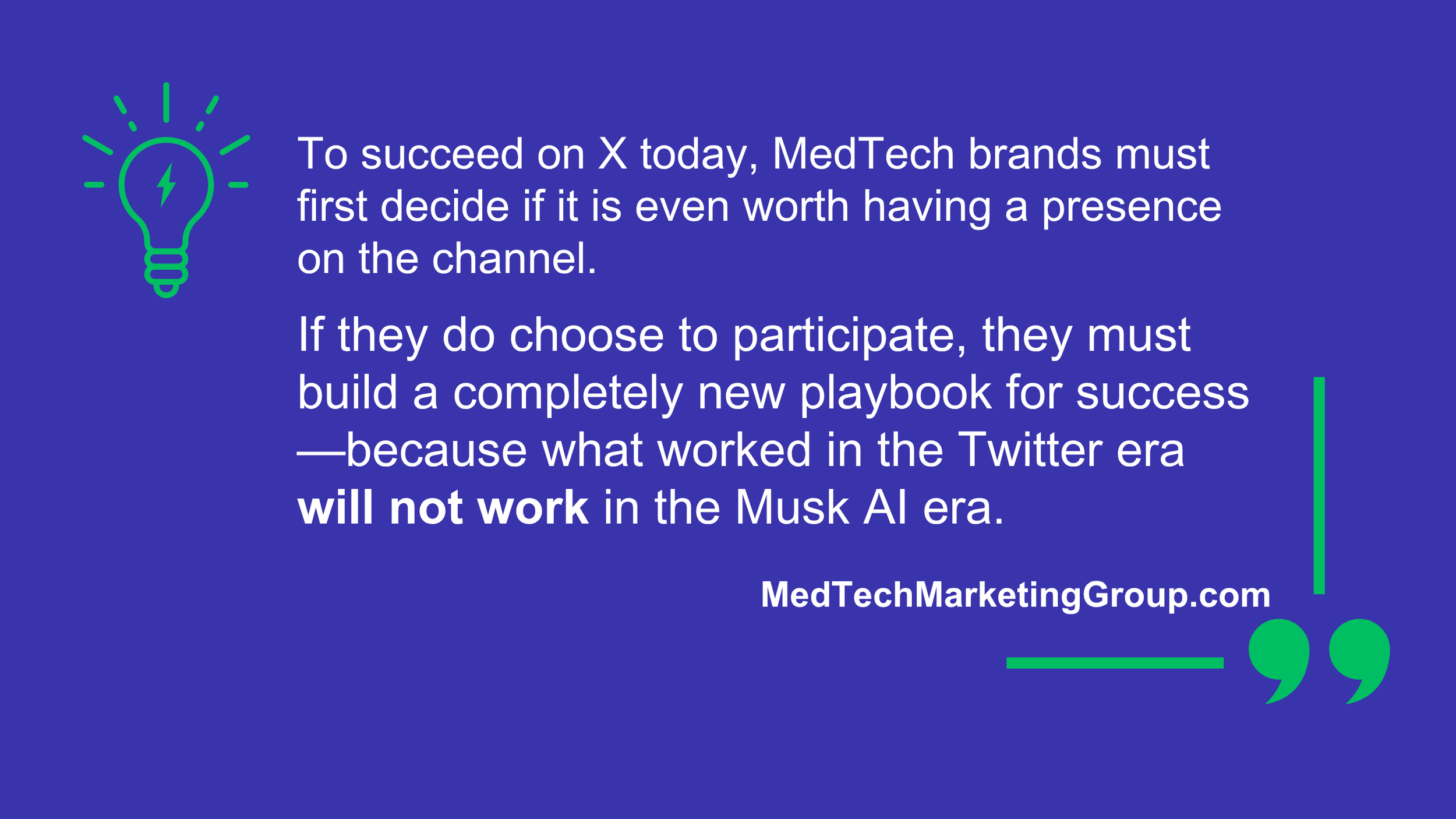
The evolution of Twitter to X has brought a fundamental change, making X feel like an entirely new platform. To succeed on X today, MedTech and healthcare brands must first decide if it is even worth having a presence on the channel. If they do choose to participate, they must build a completely new playbook for success—because what worked in the Twitter era will not work in the Musk AI era.
