

Why MedTech Needs to Rewrite Its Social Playbook for Meta
The Algorithm Shift, Part 1: The Evolution of MedTech Marketing on Facebook
Editor's Note: This is Part 1 of a 3-part series exploring the evolution of social media platforms and their implications for MedTech Marketing.
Article Summary
The Problem: Winning in today’s Meta marketing requires a different approach compared to when it was launched in 2004.
The Solution: Understanding Meta’s Andromeda AI algorithm holds the key to success as well as understanding the evolution of Facebook and how it impacted MedTech brands specifically.
The MedTech Reality: MedTech brands are limited by how they can compete on Meta today because of the industry’s strict privacy and compliance laws.
The Takeaway: To survive the modern AI feed, MedTech marketers must abandon obsolete, link-heavy approach and build native, multi-format content that builds authority without compromising healthcare compliance. Buying ads is no longer optional; it is a mandatory requirement for brand discovery and growth
How to Succeed in Today’s Social Media Marketing on Meta?
Social Media platforms have gone through a long evolution since their founding in early 2000s, and as their algorithm continue to evolve, it’s important for MedTech Social Media Managers to adapt to continue driving growth. In this article, the focus is exploring the evolution of Facebook (now Meta) and how MedTech brands can succeed.
I started working in social media marketing with Facebook back in 2009, just 5 years after the platform was launched. Facebook rolled out Organizational profile pages, and I was tasked with building my first B2B social media strategy (which actually included Employee Advocacy back then – long before it became a “strategy” for today’s organizational social media).
This proved invaluable later in my career, as I went on to develop several high-impact social media strategies with exceptional results for Facebook (now Meta), Twitter (now X) and LinkedIn (owned by Microsoft). Because I’ve watched the algorithms evolve from day one and how my audience interacts on these channels, I understand the why behind what works, which allows me to keep creating strategies that work, adapting them to the ever- changing algorithms.
The Beginning: The Organic Reach Era
When Facebook was founded in 2004, it didn’t have sophisticated algorithms that decided what you get to see. They actually showed you every single post from the people you followed in the reverse chronological order of when they posted. This meant that whenever you opened your phone or computer screen, you would scroll endlessly to see every update.
The upside: You could see every update from every person you followed. Brands enjoyed 100% Organic Reach regardless of the content formats they shared—whether plain text, images, or video.
The downside: You could scroll endlessly. There was a lot of content.
In 2007, Facebook launched “Facebook pages” for brands and businesses. Before that, if a business wanted to have a brand page, they would create a brand page using a personal profile feature and add friends as “followers.” This wasn’t sustainable long-term as users grew on the platform. By 2009, Facebook forced personal profiles to migrate to the organizational brand page structure. The term followers didn’t exist yet, so when a personal account wanted to follow a brand page, they could become “a fan” of this page. When the migration happened, all fans were automatically transitioned to followers.
2009- 2011 Emergence of the first feed algorithms
To improve interaction and sort content, Facebook introduced the EdgeRank algorithm, which determined what content to display in the newsfeed based on three criteria: relationship or affinity (how you and the creator interacted), weight (images and videos scored higher than plain text), and recency of the post.
Case in Point: Growing the First Organizational Facebook Page
In 2010, I was tasked with creating the first ever social media strategy for Facebook at the ProTransport-1 Ambulance, the company I worked at. More people and businesses were joining Facebook, so it was important to build presence but there wasn’t a a playbook available like we have today.
How did brands use Facebook pages?
The brand organizational page acted as a static billboard of sharing company’s info. The repost button was invented around 2012, so if an employee wanted to share your company’s update, they had to download the picture(s) your page posted and use it in their own post. Similarly, if a company wanted to share a photo that employee posted, you needed to ask their permission to post on your account.
It’s also important to understand how the page was managed. To manage the page, a we had to create a dummy user account to avoid linking a personal account as the login was shared among multiple people or teams. Admin panel or Meta Business Suite didn’t exist back then (Facebook rolled out Facebook Business Manager in 2014). To gain followers, a business could send a “friend request" to its employees or other personal accounts.
Marketing B2B was not easy. What are some of the strategies that helped me to succeed?
Employee Advocacy and User Generated Content (UGC) was the first strategy I introduced that helped drive growth.
The company had several locations across multiple counties in the Greater Bay Area, which meant that our rigs were on the road in vastly different environments: city streets, valleys, lakes, and beautiful Bay Area landscapes.
To drive engagement, employees were asked to take the best shots of their rigs in action and send them to us. The company page would in turn post the picture and give credit to the crew. Employees enjoyed seeing their photos as well as being mentioned by the company. They liked the posts and commented on the pictures. This signaled the Facebook algorithm to display this content in more feeds of their friends.
As the years went on and predictive machine learning developed, the page grew in followers—this time expanding from to the hospitals the ambulance served and hospital employees, admins, and even just local businesses.
2011–2013 Predictive Machine Learning Models
As Facebook continued to evolve, it integrated predictive machine learning models that studied a user's unique history to predict whether they would specifically like, comment on, or share a post. The ultimate goal was to create a highly relevant feed for each user. As a result, posts with the most likes, comments, and shares began appearing across everyone’s newsfeed, even if they weren’t relevant. Facebook looked at high engagement metrics, deemed that these posts would make users click, and pushed them out to more feeds. Some users decided to capitalize on the algorithm and began writing sensational, shocking, or polarizing headlines just to get people to click, and that’s how the term “clickbait” originated.
2014 – 2015 Time Spent Pivot
Facebook needed to fix this click-bait problem, so they retrained their models to demote these engagement-bait posts and introduced "Time Spent" as a ranking factor, measuring how long users stayed on a story or watched a video. (This is something we call Dwell Time on LinkedIn today)
Case in Point: Skyrocketing Growth with Facebook Strategy at CPMC
In February of 2014, I joined Marketing team at a hospital system. Because I already came with social media experience, I volunteered to lead and develop strategy for the Facebook account. Initial results spoke for themselves—all metrics (engagement, reach and followers) had seen explosive growth - doubling and tripping.
This success earned professional recognition when Ragan’s Healthcare Communications News mentioned the hospital’s social media strategy in their article titled "10 tips to grow your Facebook fan list." (Original article is unfortunately no longer live on their site)
How did I achieve such success? By deeply understanding the platform infrastructure and executing a strategy aligned with specific business goals:
Content pillars
Instead of posting “whatever and whenever,” I outlined a daily posting schedule and a specific topic for each day. (e.g., patient success stories, medical innovation, community health tips). This signaled to the algorithm that the page was highly dynamic.
Meaningful content drove interactions
Our audience liked the content we posted and engaged with the page – not just “liking” the post, but leaving a comment and sharing our posts. This signaled to the Facebook’s algorithm that the hospital’s account was leading high-value conversations and as a s result, amplifying our organic reach.
Connections drove reach
Facebook relied on mutual connection signals. When a user interacted with the hospital’s post, Facebook's algorithm immediately pushed that activity into the feeds of their local friends, “X liked this post.” This was especially beneficial for local brands. Because our target audience was within the San Francisco Bay Area, the algorithm pushed our posts into the connections of our followers. Keep in mind, back then, the world wasn’t as connected as today, and users' digital networks were far more localized compared to the highly globalized connections seen today.
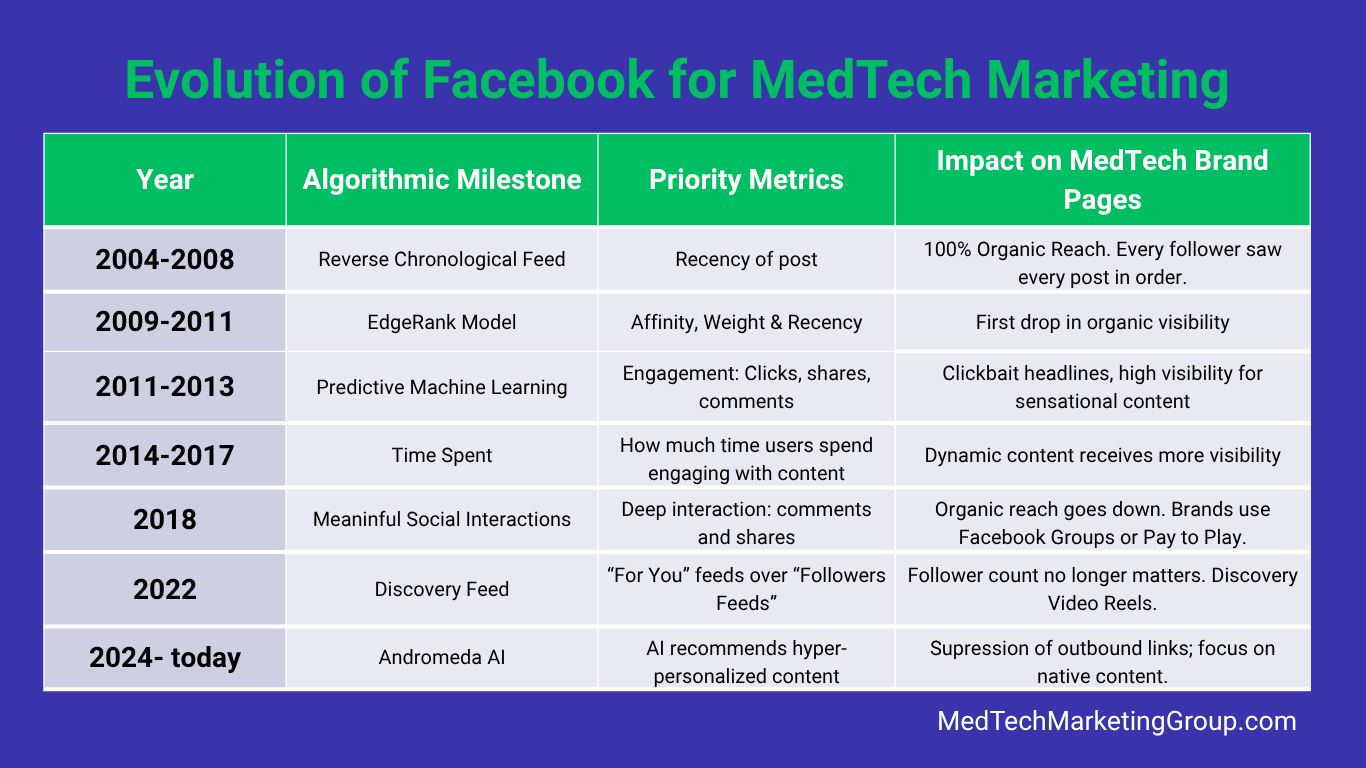
📊 [ ] Expand Data Table: Evolution of Facebook for MedTech Marketing
Year: 2004–2008
- Algorithmic Milestone: Reverse Chronological Feed
- Priority Metrics: Recency of post
- Impact on MedTech Brand Pages: 100% Organic Reach. Every follower saw every post in order.
Year: 2009–2011
- Algorithmic Milestone: EdgeRank Model
- Priority Metrics: Affinity, Weight & Recency
- Impact on MedTech Brand Pages: First drop in organic visibility
Year: 2011–2013
- Algorithmic Milestone: Predictive Machine Learning
- Priority Metrics: Engagement: Clicks, shares, comments
- Impact on MedTech Brand Pages: Clickbait headlines, high visibility for sensational content
Year: 2014–2017
- Algorithmic Milestone: Time Spent
- Priority Metrics: How much time users spend engaging with content
- Impact on MedTech Brand Pages: Dynamic content receives more visibility
Year: 2018
- Algorithmic Milestone: Meaningful Social Interactions
- Priority Metrics: Deep interaction: comments and shares
- Impact on MedTech Brand Pages: Organic reach goes down. Brands use Facebook Groups or Pay to Play.
Year: 2022
- Algorithmic Milestone: Discovery Feed
- Priority Metrics: "For You" feeds over "Followers Feeds"
- Impact on MedTech Brand Pages: Follower count no longer matters. Discovery Video Reels.
Year: 2024–today
- Algorithmic Milestone: Andromeda AI
- Priority Metrics: AI recommends hyper-personalized content
- Impact on MedTech Brand Pages: Suppression of outbound links; focus on native content.
2018 Meaningful Social Interactions and Pay to Play
In 2018, Facebook algorithm changed again and prioritized content from family and friends over public brand pages. Posts that generated more comments were dominating over posts with “likes.”
How did this change impact brand pages?
Because brand pages weren’t family or friends, organic reach went down. Brands had several options:
Facebook Groups: Companies introduced Facebook Groups because those interactions were counted as meaningful.
Pay to play: Brands had to start using sponsored content and native ad networks to guarantee their pages were seen.
Note: Facebook introduced Facebook Ads early on, but only in 2012 it allowed brands to place ads into users news feeds and target based on various criteria. Healthcare and MedTech brands were slow to adapt ads because of first of all, highly complex regulatory environment, and secondly, because brands could achieve organic growth through a solid strategy. However, more brands were forced to explore ads after organic reach went down by this time.
2022 Discovery Mode and Video Push. “New Meta”
Around 2022, Facebook (Meta as of October 2021) had another major pivot in its algorithm to compete with TikTok (launched globally in 2017/2018), which was dominating user attention with short-form video. Facebook introduced an AI-driven "Discovery Feed" model, mimicking TikTok’s "For You" page. The algorithm began pushing content from pages you did not follow, using interest-prediction models to keep you engaged longer on the platform.
This is a crucial point in its evolution because it completely changed Facebook’s (now Meta) DNA from its original concept - from social network connecting people to discovery engine for passive content consumption. Video became the new social currency.
What’s the impact to business pages?
Downside: Followers no longer mattered. Algorithm favored pages that produced reels (short, vertical videos). Pages couldn’t count on their regular content (posts, images, articles) being seen by their followers to guarantee reach.
Upside: A page can get an instant hit (and thousands of views) by posting a viral video.
This change was fundamental. Healthcare and MedTech Brands had to completely redesign their strategies for organic reach, or turn to paid advertising or leave the platform -- and they did. Many turned to LinkedIn (Covered in Part 3)
2024 -- Present
According to Meta’s engineering blog, their algorithm has improved with the introduction of Andromeda AI (referred to as “recommendation engine”) which uses a “deep neural network to scan tens of millions of posts in under 300 milliseconds to serve this content to the audience who is most likely to engaged with this content.”
What does it mean for pages?
1. Use video reels for top-of-funnel discovery
MedTech brands must post reels to reach new users. If your reel features static slides or generic images, it will be flagged as low-quality and AI will suppresses its distribution. The AI prioritizes human interactions —meaning posts featuring actual, real HCPs, KOLs or patients speaking directly to the camera. Because all content must be routed and approved in the system such as Veeva, videos content creation and approval adds additional time, which means marketers must be meticulous with planning their social media calendars.
2. Avoid posts with outbound links – AI suppresses posts containing outbound links because they want to keep users on their platform longer, forcing brands to build "zero-click" native content.
Takeaway:
The evolution of Facebook (Meta) over more than decades has fundamentally shifted the purpose of the platform to maximize revenue by staying highly relevant and competitive in today’s social media landscape. Today Meta comprises a suite of apps —Facebook, Instagram, WhatsApp & Messenger— and Facebook alone reported about $93Billion in revenue according to emarketer.
That’s why they want to keep users on the platform and suppress content with external links, as ad revenue is what brings the money. Therefore, you have to absolutely budget for Facebook Marketing if you want to drive growth for your brand and discover new audience for your products.
Social Media & Privacy: HIPAA & PHI
Social Media Marketing in MedTech and healthcare is incredible complex due to the strict regulatory environment. Marketing Managers coming from other industries such as tech, CPG or retail will have a steep learning curve because every single thing you post carries a risk. Many don’t understand it and “fight” their MLR team (medical, legal, regulatory) because they want to post quickly, especially if they see their product in use by HCPs or patients.
When you work in any healthcare sector, the two most critical acronyms you must know are PHI (Protected Health Information) and HIPAA (Health Insurance Portability and Accountability Act). These were the very first terms I learned from the compliance and ethics officer at the ambulance company. HIPAA is a federal law; when violated, it carries strict financial and criminal penalties.
PHI is basically personal data that includes any health-related information tied to a person's identity, such as medical conditions, prescriptions, date and time of the procedure, or any info paired with an IP address or email.
HIPAA is a law that outlines how this data must be protected.
How does PHI & HIPAA affect MedTech/Healthcare Social Media?
As a MedTech Social Media Manager or Marketing Manager, you have very unique content guardrails. When you post any photos from a patient case to demonstrate your medical device in use, you must blur out any identifiable information (PHI) that can be traced back to the patient (faces, date and time, location, etc), aside from obtaining a signed, official media release consent form (HIPAA). Marketers from others industries aren't even aware of these legal barriers as they post content with a simple verbal consent (or sometimes, without one!)
If you are a MedTech brand, and posted a case from the account sharing the patients history and case details without consent, you have violated both and your company can be sued.
Case Study: The Meta pixel tracking law suit
Medical brands who had Facebook pages inadvertently violated privacy laws and leaked PHI to Facebook (Meta), who used this info to serve sensitive, targeted ads to users for their health conditions.
How did that happen?
As marketers, we track performance of our various digital items -- websites, ads, content, etc. -- using specific tools designed for that. Meta had its own tracking tool called Meta Pixel which was embedded like a code on brand websites and tracked user activity (page views, conversions). MedTech Marketing Manager uses this information to understand how patients or HCPs use their websites to help optimize content strategy.
For example: A user clicks a Facebook post about "symptoms of heart disease" and visits the website. The pixel tracks that they read an article about heart disease. The MedTech marketer sees this data in their Facebook (Meta) Ads Manager dashboard to optimize their content strategy — which is a normal part of digital marketing.
However, the problem arose because the tracking pixel did not stop tracking when a user browsed private, legally protected medical portal like MyChart. Pixel tracked all info and sent it back to Meta, which then used that information (PHI) to serve highly targeted ads to that user (multiply that across thousands of users and across multiple health systems.
Consequence?
Multiple class-action lawsuits were filled against hospitals and healthcare systems for sharing private patient information with Meta through its websites and patient portals. For example, Duke University Health System had to pay $3.74 million to settle their lawsuit. Reuters reported that at least 664 hospitals and healthcare providers used the tracking pixel.
Because of this, many MedTech and Healthcare brand left Meta in 2022 and moved to other platforms, like LinkedIn.
Final Takeaway
To survive the modern AI feed, MedTech marketers can’t rely on the old playbook. You must abandon obsolete, link-heavy approach and build native, multi-format content that builds authority without compromising healthcare compliance. Buying ads is no longer optional; it is a mandatory requirement for brand discovery and growth
