

Why On-page Elements Still Matter for MedTech Webpages in the AI Era
Article Summary
The problem: MedTech product webpages that aren’t optimized for AI, will not be pulled up in AI search summaries.
The Solution: Website optimization includes multiple elements, including on-page SEO —meta descriptions, title tags, headings, and alt text—and must optimize your webpages across all of these categories to maximize visibility.
The MedTech Reality: Website optimization isn’t on top priority list for PM; it’s either overlooked or outsourced. However, it is no longer enough to just hire a standard copywriter to write your webpage; today, your copywriter must be deeply skilled in both your specific product and the technical art of writing for Web AI.
The Takeaway: Marketing must provide an AIO checklist detailing needed webpage and metadata changes, while the PM provides specific clinical data, publications, MOAs, and testimonials before marketing executes the final launch.
AI search had undoubtedly changed how search engines respond to user search queries which means MedTech Product Managers and Marketing Managers must optimize their product webpages for AI.
In website optimization (web SEO), there are multiple components that play a role in getting your website displayed in AI search summaries. In my last article, I covered how to optimize a product webpage from a content perspective,and in this article, I am covering how to optimize a product webpage for the five essential on-page SEO elements: meta name and meta description, title, headings, and alt text for visual media. The purpose of these on-page elements is to make your content easy for computers to read and contextualize, allowing generative search engines to display your website in AI summaries today.
A short history of SEO Evolution: from HTML to Structured Data
This part can be a bit too technical for a product manager, so you can skip ahead to the section about The AI Era. However, if you are curious to learn more about SEO and expand your digital marketing knowledge, you may find this not only interesting, but gain a better understanding of why SEO matters.
The HTML Era
When we first started building websites, we used HTML language. It would tell a browser how to display text on the screen, meaning it was a formatting language. When a browser looks at a webpage, it reads HTML to see where to put text blocks, images, dividers.
It looked something like:
<H1> Main Heading </H1>
<p> text about this page </p>
<H2> Subheading </H2>
In this case, H1 tags represent main headings, H2, H3 represent subheadings and so on. <P> represents paragraph or the description text.
How do I know this? When I was in college 20 years ago, I took an HTML class out of curiosity because I thought it would be cool to learn how to build webpages. Little did I know then that webpage management and SEO would become so prominent throughout my MedTech career—from my very first job to the present day, where I help MedTech companies optimize their webpages for Web AI.
However, HTML didn’t tell the browser what the text was about and its meaning, but computers needed to understand webpage context. That’s where keywords and keyword stuffing came in, including in the on-page elements.
Meta Name & Meta Description
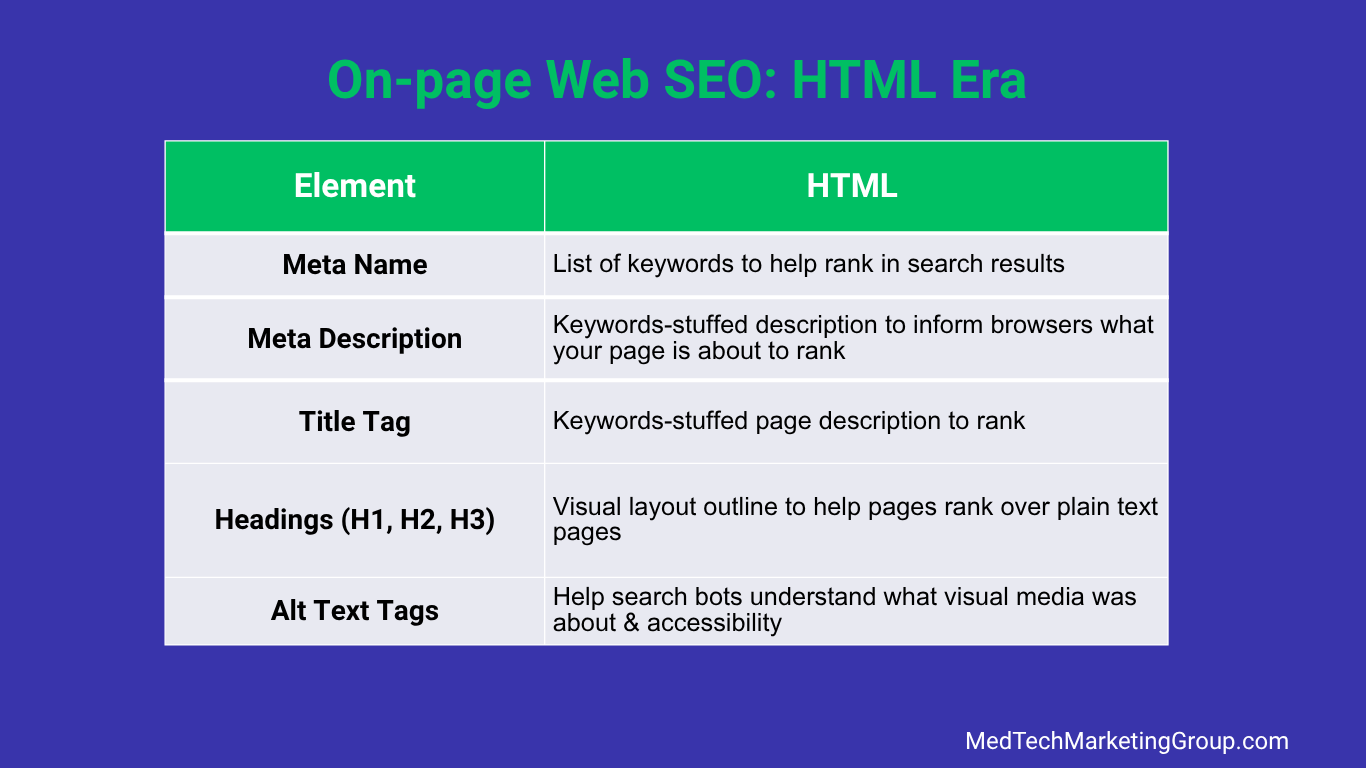
Meta name and meta description are hidden tags in the HTML code that were managed by webmasters, IT teams, or skilled marketing managers—professionals like me who possess a deeper level of expertise than the average marketer. This code was read only by computers, and through the use and abuse of keywords, we could tell the browser what the page was about. Why did webmasters overstuff these hidden tags with repetitive keywords? They did it to help search bots understand the page topic and to push it higher in the search results.
If you are a product manager in medical device, you may have been hunted down by your marketing teams for product keywords. Marketing would use these keywords to write meta name and description or would outsources to web managers or web agencies. In my role as a Digital Product Marketing Manager at Abbott, I handled this component myself because I had the required product expertise and digital expertise. I knew my product specific keywords and knew how to optimize webpages for SEO, and that’s why the 6 webpages I wrote, all ranked on the first page of SERP.
Throughout my career, I have seen many webpages with blank values for these tags, and fixing those gaps is exactly what I would look for when performing a website audit.
Is PM or Marketing Manager responsible for website SEO?
This responsibility should absolutely fall within a marketing or marketing operations team, and certainly not on product managers, who already have their hands full with all-things product. However, in nimble companies where a product manager operates without the support of a marketing counterpart, team, or agency, webpage management falls through the cracks and gets deprioritized. This is deeply ironic, because your product webpage is your central hub for driving product interest and conversions which ultimately leads to product sales within the customer journey marketing funnel. When your product webpage isn’t being pulled up in organic search results, you aren’t prioritizing what matters—and that is exactly why you end up spending too much of your precious MedTech budget on paid traffic.
Title Tags (Page Titles)
The same logic was applied to title tags as page titles told browsers what the page was about, which meant adding a lot of keywords.
Headings
Headings served a slightly different purpose: they gave the page an outline and somewhat of a structure (headings presented a hierarchy of headings and subheadings, like an story outline). Because the webpages were ranked based on these on-page elements, therefore, pages that had headings were ranked better then pages that just had plain text.
Note: even during early HTML days, search engines looked for clean, organized and structured content that was easy to read.
Alt-Text Tags (Visual Media)
One rule of web SEO in the HTML days was adding Alternative Text [alt text] to all visual media on a page—including images, charts, and videos. This required a description of what the visual actually contained, because to the browser, all visual media simply looked like empty boxes.
Why did it matter to add alt text tags?
1. To improve accessibility, i.e. to ensure people with disabilities can read the webpage too. If you visual contains clinical data, you’d write this description: A chart displaying device X results in the Clinical trial ABC.
2. To help bots understand the content of your visual media to be able to rank the page.
What happened if alt text tags were missing?
If Alt text was missing, your webpage could take a dip in ranking.
If you look at the bigger picture and the implications of missing elements from an SEO checklist, they all add up and negatively impact your webpage ranking. And that is exactly why I frequently heard product managers and marketing directors asking: "Why is my page not displaying on the first page of search results?" One or two missing SEO elements won’t tank your visibility, but once you add them up across multiple categories—as I explained in my Web SEO 101 article before the AI Era—they absolutely will.
[+] Expand Data Table: On-Page SEO Elements
| On-Page SEO Element | Core Function in HTML Era | AI Era Evolution & Purpose |
|---|---|---|
| Meta Name & Meta Description | Hidden tags stuffed with repetitive keywords to trick search bots into ranking the page higher. | Act as an authoritative executive summary (under 150 characters) for AI engines to scan before reading the full page. |
| Title Tags (Page Titles) | Keyword-heavy labels used primarily to signal topical relevance to search engine crawlers. | Clear, definitive boundaries that AI scans to establish the scope, depth, and citation links for conversational answers. |
| Headings (H1, H2, H3, H4) | Simple structural outlines used to organize text blocks; pages with headings ranked higher than plain text. | Advanced semantic roadmaps that summarize paragraphs, map out topical depth, and match user-intent questions. |
| Alt-Text Tags | Text descriptions used to help basic search bots rank the page and improve accessibility for disabled users. | Critical multi-modal context that AI uses to serve text answers, extract graphic data, or fulfill direct media requests. |
Structured Data (Schema)
In 2011, search engines—Google, Microsoft (Bing), and Yahoo!—rolled out Structured Data, introducing a universal vocabulary called Schema to help search engines read the content of a webpage. Schema.org served as a standardized guide to help webmasters label content using a special data format (you may have heard of JSON-LD, which looks a bit like JavaScript) so that search engines can understand exactly what the webpage is about, its context, and how different pieces of content relate to each other. Essentially, Structured Data provided a machine-readable fact sheet. Two key things to help you understand this concept better:
Schema was handled by IT or webmasters
Its impact was seen only on the back-end (i.e. think of it as a code hidden away in HTML)
Here’s a comparative example HTML vs Structured Data on the back-end
HTML: Title < Device Name, Manufacturer</title>
Structured Data: { "@type": "MedicalDevice", "name": "Medical Device Product Name"}
In a nutshell, Schema was a way to verify your HTML content and signal to search engines that content is accurate and factual.
Think of it this way: a programming language tells a computer what to do, HTML tells it how to look (to display), and Structured Data tells it what something actually is.
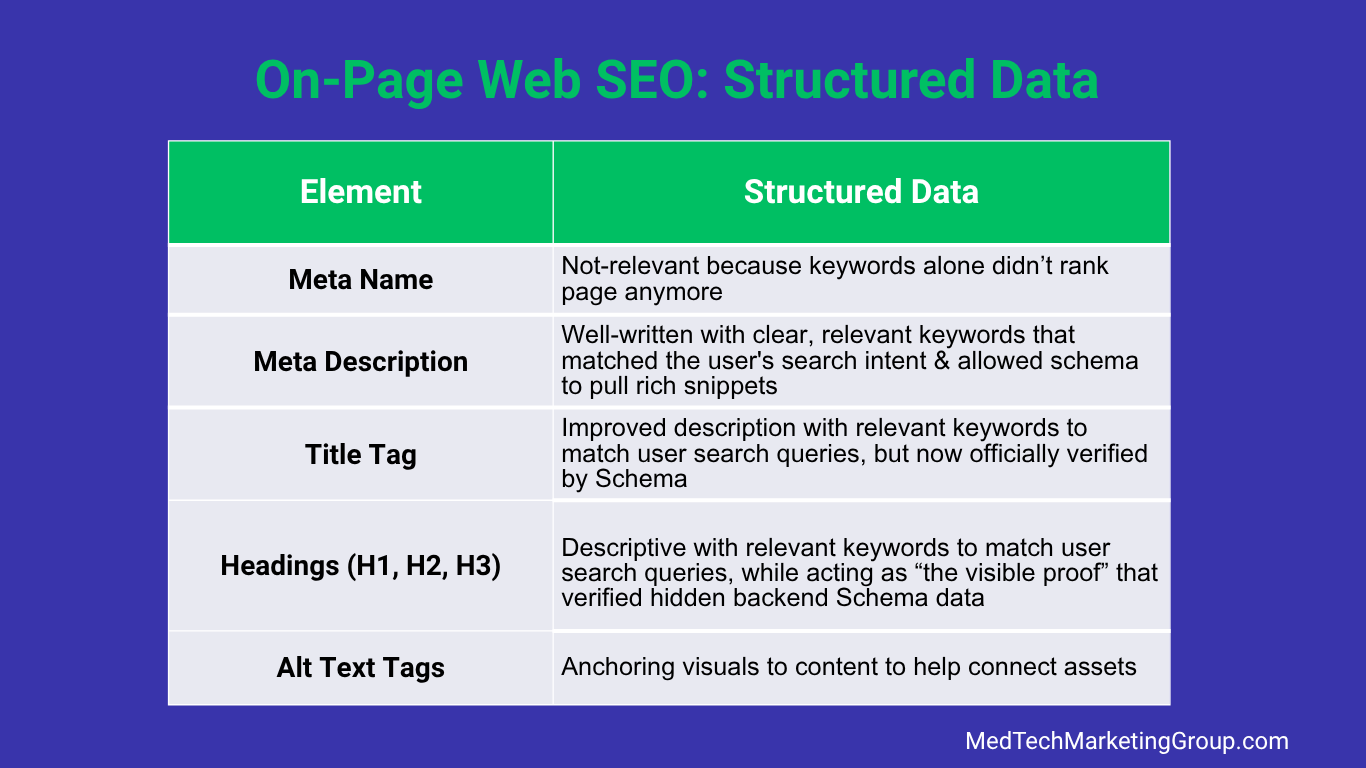
In the same manner, Schema impacted all other on-page SEO elements - meta description, headings, alt txt (meta name didn’t matter anymore because structured data took care of it). I’m not listing examples for each element because it is just too technical and was handled on the back-end.
How did Schema work?
The Schema.org website provided a guide explaining exactly how to use this code for your specific industry. For high-risk Class III medical devices, like heart valves or pacemakers, it allowed websites to use a specialized medical vocabulary to explicitly label the page (e.g., product type = medical device, name = product name, etc.).
Schema, Rich Data and Rich Snippets
When Schema was rolled out, it introduced Rich Data (also embedded directly into the HTML by webmasters or IT teams on the back-end) which allowed search engines to better contextually analyze a webpage and read its content not only faster, but much more accurately. Accuracy is especially critical for medical devices because Google needs to understand indications for use and safety information to properly display the website in search results. For a Class III medical device website, Rich Data explicitly proves to the search engine whether the device is FDA approved or has published clinical data, for example.
While Rich Data is completely invisible on the page, the Rich Snippets is what visible to users. If your product webpage included a product FAQ, those questions and answers are pulled from the code and displayed directly in the search results as snippets. And because Class III medical devices normally do not list consumer prices, these professional FAQ dropdowns was a way for a medical device company to stand out on the screen.
Some product managers may remember pages with Rich Snippets displaying differently in search results—they took up more physical space and had additional dropdown content—which often led PMs to ask, "How can I get my product webpage to display like that?" This really highlights how visual product managers are. They scroll online, notice something premium that their own product page lacks, and immediately request the same from their marketing teams.
However, if that approach is flipped—where a marketing manager proactively suggests optimizing the webpage for structured data—the request is often deprioritized or, worse, ignored. That is because PMs already have a lot on their plate to manage, and because it is hard for a PM to comprehend the impact of website SEO and background code, which is completely understandable. The point is, when PMs and Marketing Managers work closely together and each side truly understands the underlying goals and the impact of a project, the results show it—you get your product noticed by the right audience and you drive real conversions.
[+] Expand Data Table: Structured Data (Schema) Era SEO Elements
| On-Page SEO Element | Core Function in Structured Data Era | Technical Impact (The "Behind-the-Scenes" Code) |
|---|---|---|
| Meta Name & Meta Description | Meta name tag lost its importance; description focus shifted toward accuracy over keyword density. | Schema code explicitly validated the accurate summary, signaling factual consistency directly to search engines. |
| Title Tags (Page Titles) | Continued to serve as the primary title identifier, but verified by backend structured code. | Explicitly mapped on the backend: { "@type": "MedicalDevice", "name": "Product Name" } to ensure brand accuracy. |
| Headings (H1, H2, H3, H4) | Maintained a logical, hierarchical story outline to ensure clean page architecture. | Rich data crawlers used headings to cross-reference text content with the factual claims made in the Schema code. |
| Alt-Text Tags | Remained critical for web accessibility while providing deep, contextual descriptions of visual media. | Allowed medical device companies to contextually prove indications for use, FDA approval status, or clinical trial parameters to search bots. |
The AI Era
When AI was rolled out in the beginning of 2026, it has fundamentally changed how people use search engines. Google is not a search engine anymore, it’s an answer engine, often called Generative Search Engine (GSE). Search engines now pull up short summaries to answer a user’s the search query. This means that it has impacted SEO and how we optimize webpages for SEO.
How did AI impact on-page SEO elements?
Meta name tag
Meta name tag no longer matters as AI doesn’t rank webpages based on keywords.
Meta description
Meta description still matters. What has changed is how your write the description. Before, the goal was to write a basic description with as many keywords as possible [for ranking]. Today, the goal is to provide a comprehensive description that acts as an executive summary that captures the entire depth of the webpage and fits into 150 characters. When AI scans the web to answer a user’s search query, it reads meta description to understand the context of the webpage before it proceeds scanning the entire webpage and determine if the content will satisfy a user’s query.
What does this mean for MedTech Product and Marketing Managers? This is an easy fix. Review your webpages meta description and re-write as an executive summary.
Title Tags (Page Titles)
Title tags still matter and their function hasn’t changed because they tell search engines exactly what a page is about. They are like labels — precise, definitive “headings” that tell AI what the page is about covering scope and topical depth. When AI scans a website for a conversational answer, it scans title tags and pulls them in summary citations.
What does this mean for MedTech Product and Marketing Managers? Make sure you page titles are clean, descriptive and accurate.
Headings
Headings act as a structured outline of your topic. While they were primarily used to help rank pages back in the HTML days, today this outline serves a more advanced purpose: it helps to map out the depth of your topic, so that both people and AI can navigate it effortlessly. This means your headings should summarize the content of that specific paragraph, further adding to the depth. Learn more about how AI impacted webpage content and how you can optimize them for AI within then E-E-A-T framework.
What does this look like in MedTech?
If a patient or an HCP is searching for your product, they can ask conversational questions and full sentences, and AI scans your website for matches to their queries. If your heading matches the query, AI will identify this specific section and pull in AI summary. When you write about your product, your heading and subheading can include:
· How does product X help to diagnose disease X?
· What clinical data supports Product X?
· What Clinical Trials support Product X?
· What do HCPs say about using Product X?
What does this mean for MedTech Product and Marketing Managers? Review your webpage content for topical depth using E-E-A-T framework and rewrite headings to better capture the content of each section and use questions for writing headings.
[+] Expand Data Table: Evolution of Web SEO Across Three Eras
| On-Page SEO Element | The HTML Era | The Structured Data (Schema) Era | The AI Era (Generative Search) |
|---|---|---|---|
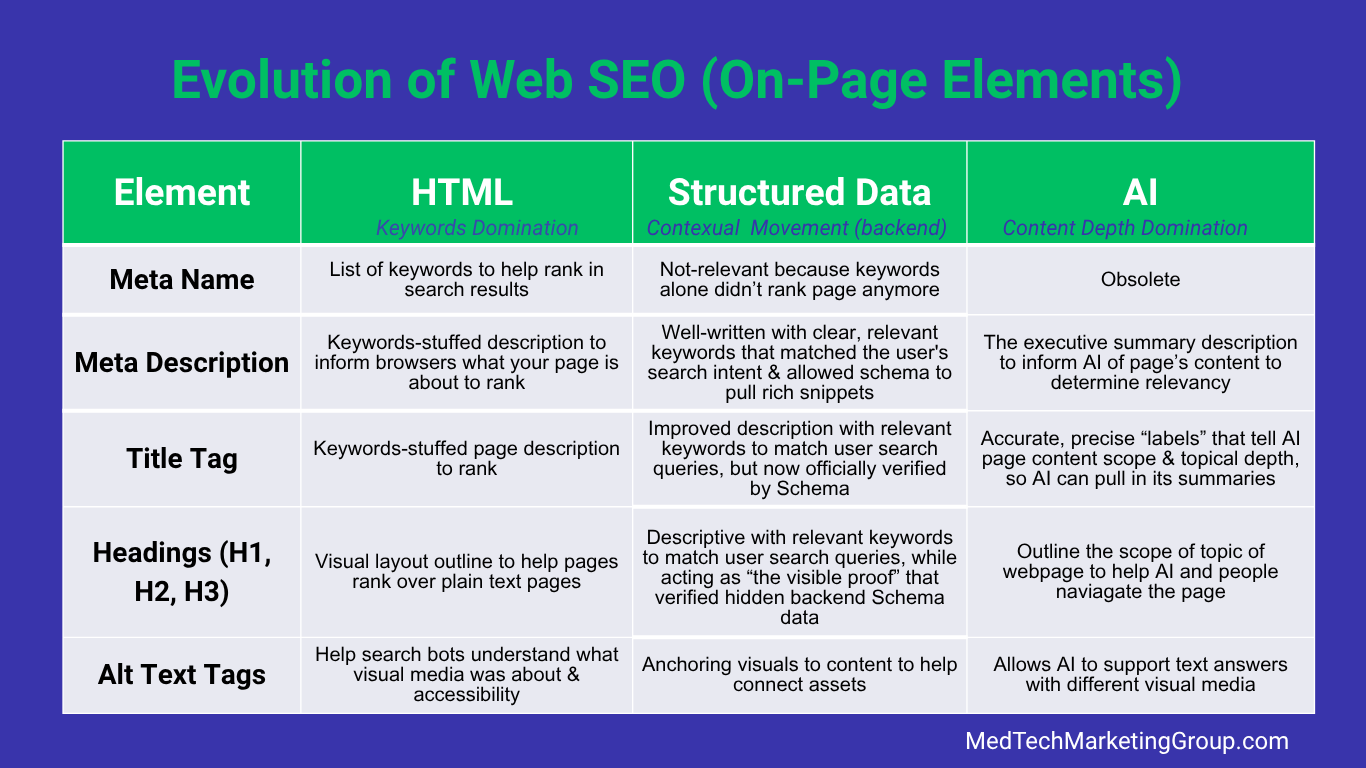
| Meta Name | Stuffed with hidden keywords to rank higher. | Devalued; backend structured data took over its function. | Completely obsolete; AI ignores keyword tags. |
| Meta Description | Basic, repetitive keyword block used for ranking bots. | Shifited focus toward accurate, backend-verified summaries. | Critical 150-character executive summary used to evaluate page depth. |
| Title Tags | Keyword-heavy labels to signal topical relevance. | Monitored for brand accuracy and verified by schema code. | Precise boundaries used to establish scope and generate citations. |
| Headings | Simple structural outline; prioritized over flat text. | Hierarchical roadmap used to cross-reference code facts. | Advanced semantic roadmaps matching conversational user queries. |
| Alt-Text Tags | Basic text descriptions of image files for accessibility. | Contextual backend proof of clinical data and approvals. | Multi-modal context used to serve rich text, graphics, or videos. |
Alt Text Tags
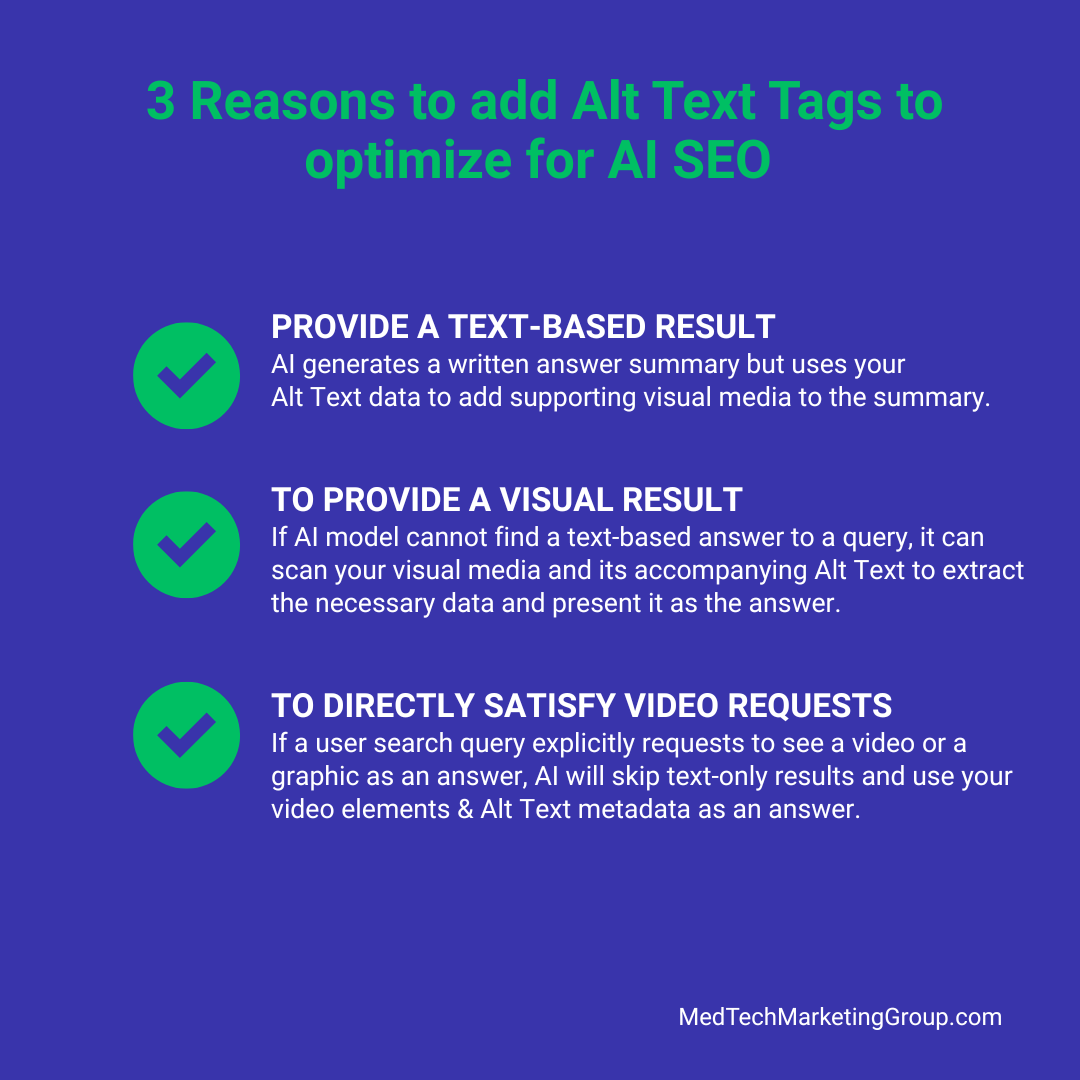
Alt Text Tags (for visual media) still matter for accessibility first of all, and for SEO. When AI scans the web, it doesn't just read your website copy, but analyzes all visual and rich media, including images, videos, audio, tables, and charts. This enables AI to read Alt Text and use that information to satisfy a user's search query in three ways:
Provide a Text-Based Result: AI generates a written answer summary but uses your Alt Text data to add supporting visual media to the summary.
To Provide a Visual Result: If AI model cannot find a text-based answer to a query, it can scan your visual media and its accompanying Alt Text to extract the necessary data and present it as the answer.
To Directly Satisfy Video Requests: If a user search query explicitly requests to see a video or a graphic as an answer, AI will bypass text-only results and use your video elements and Alt Text metadata as an answer.
Note: Alt text tags matter not only on your website, but across all social media channels or any platform where you share visuals and videos because everything is scanned by AI in search of answers. If you post on LinkedIn, you may have noticed that there’s an option to add ALT TEXT to visual media, and a separate place to add video title, even if your video already has on screen title. Learn why this is important from SEO perspective.
Important Note for Charts and Tables:
While adding Alt Text to image-based charts and tables helps AI identify that a dataset exists, text inside flat image files (like JPEGs or PNGs) cannot be easily read by AI data-mining engines.
The Flaw: An AI bot cannot read individual cells inside a photo to answer complex mathematical user queries.
The AIO Fix: For tables and charts, do not rely on Alt Text alone. You must pair your visual graphics with native HTML or Markdown text tables directly beneath the image to ensure the AI can read, extract, and cite your exact data points. (Don’t be intimidated by HTML or Markdown language - simply ask the team who manages your website)
What does this mean for MedTech Product and Marketing Managers? Review all visual media on your webpages and add descriptive tags, so AI can understand exactly what is displayed and use it for answers. If you have a visual that shows clinical data results (not a chart), your alt text can say: This is an image of medical device product X displaying results from the clinical trial Y published in ABC.
What’s the best way for PMs and Marketing Teams to collaborate on AI Optimization (AIO)?
The role of Marketing should be to provide an AIO checklist outlining exactly what changes are needed—from on-page SEO elements to core webpage content. From there, the PM can provide direct input on product-specific information that needs to be revised or added, such as clinical trial data, publications, mechanism of action (MOA), and physician or patient testimonials, while Marketing leads the implementation.
Ultimately, it is no longer enough to just hire a standard copywriter to write your webpage; today, your copywriter must be deeply skilled in both your specific product and the technical art of writing for Web AI.
Make no mistake: AI cannot write your website copy for a medical device product. AI doesn’t understand Important Safety Information (ISI) and clinical risk, it doesn’t understand the true scope and depth of clinical trials, and it will never be able to write copy that provides real topical depth—simply because AI isn't trained on your proprietary clinical expertise.
AI doesn’t pull up your product website in search summary? Get in touch for a website audit and an action plan.
Final Takeaway
To make sure you product webpage is pulled up in AI summaries, you need to optimize your webpages for AI, including on-page elements — meta description, titles, headings and alt text for visual media. This task should be performed by either PMs or PMs in collaboration with Marketing. Initiate a website audit to outline what changes are needed, make the changes and route in your CMS, such as Veeva, to stay compliant.
Need a website audit? Get in touch today.
