

Optimizing MedTech Product Webpages for the Web AI Era
For MedTech Product and Marketing Managers, winning the shift from traditional Web SEO to generative AI requires a completely new approach. With the introduction of Search AI in the beginning of 2026, Google search has changed – it is not a search engine anymore, it’s an answer engine, often called Generative Search Engine (GSE). Search engines now pull up short summaries to answer a user’s search query. To ensure that Google pulls up summary from your website, and not other sources, you need to optimize your website for Web AI.
Article Summary
The Problem: If your website is not optimized for AI models, AI will simply skip your product pages when displaying search summaries.
The Ultimate Risk: If your website isn't pulled into the AI overview, your competitor's website will be.
The Solution: The E-E-A-T Framework & Content Depth: Traditional keyword density metrics are obsolete. Winning the shift to Search AI requires structuring on-page content to satisfy Google’s E-E-A-T framework (Experience, Expertise, Authority, Trust) and content depth.
The Takeaway: This guide provides an actionable AIO (AI Optimization) roadmap for MedTech Product and Marketing Managers to audit, structure, and optimize product pages for maximum visibility in generative search summaries.
From Keyword Matching & Density to Content Depth and Search Intent
Before AI, content strategy revolved entirely around keywords. Exact-match terms and strict keyword density dominated webpages because they directly dictated a page’s ranking in Google Search results. To game the algorithm, marketers relied heavily on keyword frequency—a standard practice of packing one to two target keywords into every 100 words of copy.
If you are a Product Manager, you probably remember when Marketing Managers were hunting you down to ask for your product specific keywords, and you may not have had an idea what those were, besides your product’s name.
I have been leading web SEO management as one of my core responsibilities for nearly two decades. Throughout this time, I have not only watched the digital landscape evolve, but I have been deep in the trenches writing webpages and optimizing for SEO. During my time as a Digital Product Manager at Abbott, and later as a marketing consultant, my full-stack digital expertise enabled me to write product webpages while implementing SEO best practices. In these roles, I developed six product webpages completely from the ground up—managing everything from concept development to content creation and SEO optimization—ultimately ranking them at the top of the SERPs. In fact, the most comprehensive of those pages are still being pulled directly into AI summaries today.
Around 2020, SEO underwent a major shift when Google introduced a neural network-based language processing model designed to understand conversational queries and natural human language. In response, I started writing web copy that answered genuine user questions to help search engines better understand page context. This shift required longer webpages, creating a constant debate with Product Managers who preferred short, slick, minimal copy with beautiful photos and video clips inspired by the consumer tech industry. This tension serves as another reminder that the traditionally sales-driven medical device industry benefits immensely from digital expertise. Combining technical product insight with marketing strategy creates a highly effective, symbiotic partnership.
Takeaway:
With the integration of AI, search engines shifted away from counting keywords to evaluating the content and context of your page. In other words, the algorithms analyze topical depth and user intent to determine whether your site delivers real authority.
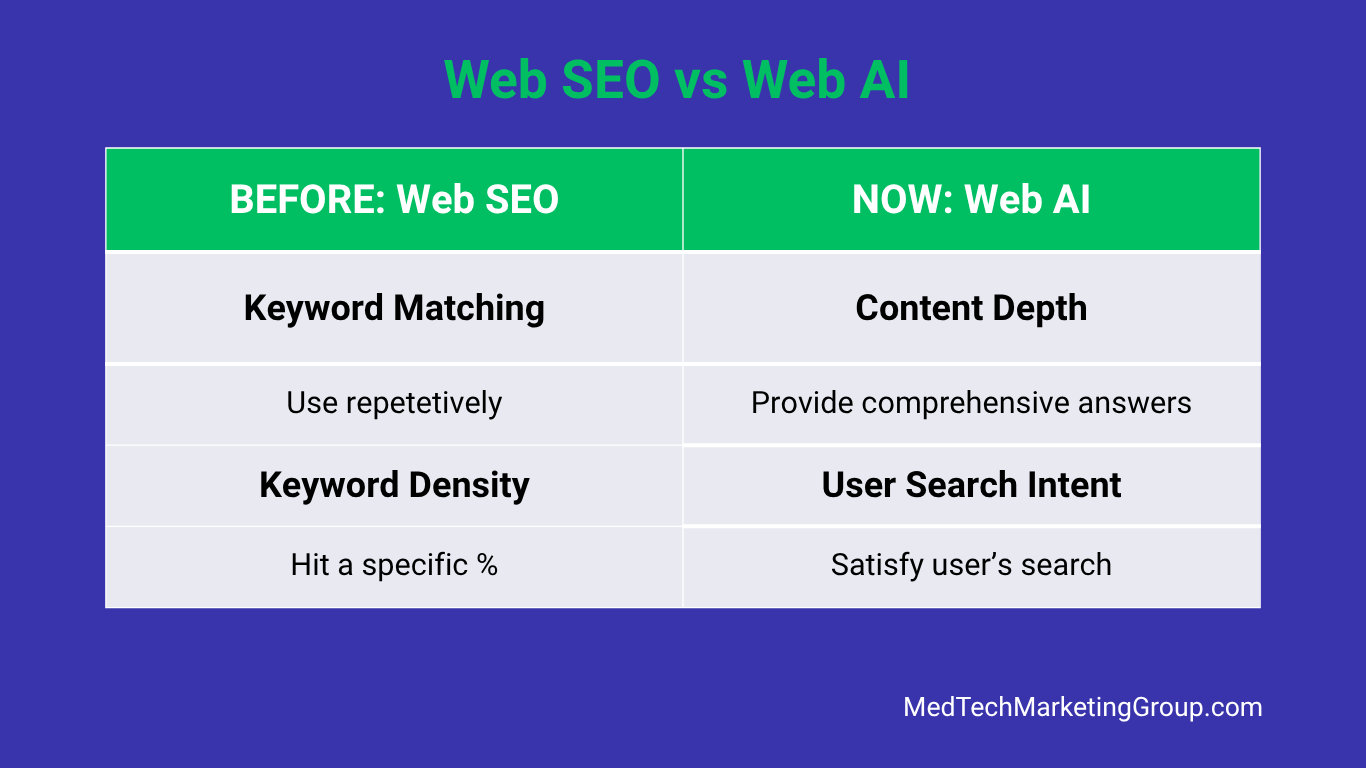
[+] Expand Data Table: Web SEO vs. Web AI Performance Architecture
| Performance Vector | Traditional Web SEO Era | Modern Web AI Era (Generative Search) |
|---|---|---|
| Primary Algorithm Focus | Exact-match keywords and strict keyword density counts (1-2% frequency). | Content depth, comprehensive contextual understanding, and user search intent. |
| Content Strategy | Shorter, streamlined pages designed to trap specific crawler keywords. | Long-form, highly authoritative pages with deep topical and clinical resolution. |
| System Identity | Search Engine Optimization (SEO) tuned for indexing web crawlers. | AI Optimization (AIO) built for conversational, generative answer engines (GSE). |
| Success Metric | High rank on the Search Engine Results Page (SERP) link indexes. | Direct citation and inclusion within AI-generated search summaries and overviews. |
Optimizing for Web AI: The E-E-A-T Framework for MedTech
When an HCP types your product name into an AI search engine, the primary goal of the system is to pull up the most relevant summary to answer “the why” behind their query. To do that successfully, the AI needs to collect enough comprehensive information about your product to fully grasp its clinical context, which is exactly why topical depth has become so critical. To provide this summary, the AI scans the entire digital landscape—including your own corporate website, medical publication networks that mention your product like TCTMD, EuroIntervention, NEJM to name a few, and an enormous database of social channels ranging from your official company handles and employee advocacy posts to YouTube videos and individual KOL accounts sharing cases or conference data.
As Google, or any search engine, combs through this massive amount of information, it isn't just looking for random data, but rather for content that is actively validated by the Experience, Expertise, Authoritativeness, and Trust framework. This E-E-A-T framework is designed to evaluate whether your brand acts as a legitimate industry expert, or if you are simply trying to game the system with AI-generated content (a clever little "gotcha" from AI).
How can medical device PMs optimize product webpages for AI within the E-E-A-T Framework?
Experience: First-Hand, Real-World Evidence of Your Product in Use
To prove Experience to Web AI engines, your content should address:
Does your website show HCPs actively demonstrating your product? (Including video clips of them sharing their personal, first-hand experiences in the lab or clinic)
If you operate in the direct-to-consumer (DTC) space, are you sharing authentic patient stories? (Highlighting real-world outcomes and journeys)
Expertise: Clinical Science Behind Your Product
To prove Expertise to Web AI engines, your content should address:
Does your website feature detailed Mechanism of Action (MOA) videos?
Do you publish comprehensive clinical and engineering specifications? (Including detailed explanations of how the device seamlessly integrates into an HCP's existing clinical workflow)
Are you sharing in-depth testimonials from KOLs and HCPs? (Specifically focusing on investigators and clinicians who were intimately involved in your product’s early clinical trials and development)
Is your product webpage missing these critical E-E-A-T signals? Get in touch for a comprehensive Web AI audit and a customized action plan.
Authority: Validation by Peers, Industry and Market
To prove Authority to Web AI engines, your content should address:
Is your product cited in elite, peer-reviewed journals? (e.g., The Lancet, NEJM, JAMA, The BMJ, JCO, Nature, etc.)
Is your data backed by robust clinical evidence? (Including published RCTs, multi-center registries, or meta-analyses)
Does your product or tech have official regulatory backing? (e.g. FDA approval, 510(k) clearance, or CE Mark)
Has your device or engineering team won recognized industry awards?
Every one of these items tells Google that you hold authority in the market. For example, if your product is studied in RCTs or published in the Lancet, you are essentially leveraging the journal’s prestigious reputation to establish your product’s authority in the medical community.
When a medical device carries official FDA approval or clearance, it serves as an undeniable signal that the technology has been thoroughly vetted for market use by a major regulatory authority, providing immediate clinical validation.
For high-risk Class III devices and technologies, a formal pre-market approval (PMA) indicates that the agency has directly reviewed the data to confirm safety and effectiveness. For a Class II devices, 510(k) clearance validates that the device is substantially equivalent to a trusted predicate. Thus having this regulatory backing on your website signals to Web AI to trust your clinical claims and pull your content into search summaries.
Note: Authority and Trust signals work together, and the specific clinical content you publish can simultaneously check both boxes for Web AI engines.
Trust: Compliance and Safety
Trust represents the most important pillar for Google. It wants to know if your website provides factual, accurate data that Google can trust before it displays it in search results.
To prove Trust (Trustworthiness) to Web AI engines, your content should address:
Does your product webpage clearly display Important Safety Information (ISI)?
Is your product cited in medical journals?
Is your data backed by robust clinical evidence?
US vs OUS Differences for ISI
If you are Medical Device Product Manager in the US, the first phrase that you should associate with trust is Important Safety Information (ISI). This statement displays Warnings, Indications, Precautions, Complications and Adverse Events (affectionately knowns as WIPCA) which are required by the US FDA for all promotional materials. Your US website must have a standalone webpage that prominently displays ISI because your website is a promotional material for your product.
However, if you are a product manager operating outside the United States (OUS), you navigate entirely different regional frameworks. Instead of building a dedicated, standalone ISI webpage, OUS regulations typically require you to add a direct link to the formal Instructions for Use (IFU) in your website's global footer or boilerplate copy. This IFU statement directs HCPs to the official product manual to review those exact same crucial WIPCA elements, ensuring global regulatory compliance.
Claims, Citations, Sources: The Regulated MedTech Framework
Beyond regulatory compliance, using RCTs and citing medical journals also send trust signals to Web AI engines.
When writing copy for a medical device website, you use clinical claims to describe specific benefits or outcomes, i.e. “Product X showed 25% reduction in ...” or “Product X leads to better cardiovascular outcomes that Product Y.” Because medical devices operate in a highly regulated industry, every single claim must be meticulously backed up by a verified source.
That is why healthcare and MedTech marketing is so challenging, and it explains why product managers or marketers coming from consumer goods (CPG), retail, or tech often face a steep learning curve. In this space, you cannot simply write a slick, witty headline and call it a day. Every claim must be explicitly supported by proven science. So when you cite your product claims by anchoring them to published RCTs, peer-reviewed journal articles, or official NIH databases, you signal Google and other generative search engines that your product data is safe, transparent and can be trusted to be displayed.
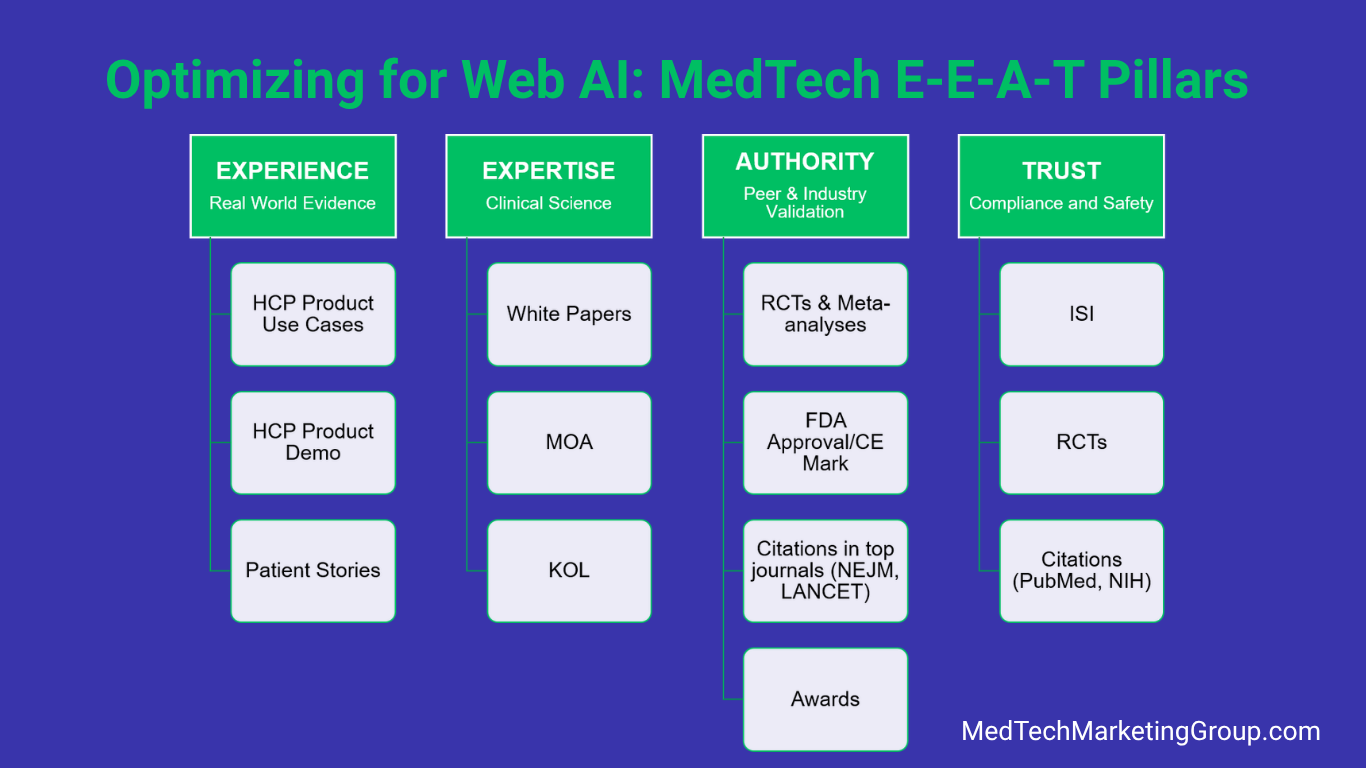
[+] Expand Data Table: MedTech E-E-A-T Optimization Framework
| E-E-A-T Pillar | Core Strategic Focus for MedTech | Authoritative On-Page Proof Elements |
|---|---|---|
| Experience | First-hand, real-world proof of medical products actively functioning in clinical settings. | • Video clips of HCPs using devices in labs/clinics. • Verified real-world patient journey stories (DTC). |
| Expertise | Concrete documentation of the clinical science and technical engineering behind the device. | • In-depth Mechanism of Action (MOA) animations. • Workflow integration guides and workflow specs. • Technical trial testimonials from early investigators. |
| Authority | Third-party validation of clinical efficacy by peers, regulatory bodies, and the broader market. | • Citations in top-tier medical journals (NEJM, Lancet). • Published RCT data, meta-analyses, and multi-center registries. • Official regulatory stamps (FDA Approvals, 510(k), CE Marks). |
| Trust | Regulatory compliance, consumer safety transparency, and data validation. | • Prominent US Important Safety Information (ISI) with WIPCA. • OUS footer links to official Instructions for Use (IFU). • Claims strictly anchored to NIH databases or clinical source data. |
Final Takeaway?
It’s not enough to just write a medical device website describing your product. There’s a right way and a wrong way to do it. To stay relevant in today’s AI era, MedTech Product Managers and Marketers need to optimize product websites for Web AI.
