

What is SEO and Why Does My Website Need It?
Authors Note: This article was written before AI changed search Web SEO in early 2026 and it has greatly changed SEO. Check out an updated post about How to Optimize MedTech webpages for Web AI. If you want to learn about the traditional SEO, this article covers it.
“How can I get my website to display on the first page of Google results?” is the most common question marketers are asked. SEO is the answer. Or more precisely, optimizing your website for SEO.
What is SEO?
SEO or Search Engine Optimization is the ability of your webpage to display in unpaid (organic) search engines results. This means that the position your website has in the search results will impact your website’s organic traffic. Strong SEO will drive consistent organic traffic. In this article, I will provide an overview of the things Product Marketing Managers can do to improve their website SEO.
I first started working on web and SEO back in 2009-2010. Even though the actual term was coined around1997, the industry erupted when Sergey Brin and Larry Page launched Google in 1998 and introduced PageRank algorithm which was mainly based on quality and quantity of external links and not on keywords or intent. The field has evolved completely over the last three decades and I was there to witness it (in the trenches!) as SEO management has been one of the constant core responsibilities in every job I’ve held. During my time as a Digital Product Manager at Abbott and later as marketing consultant, I led the end-to-end creation of 6 product websites (imaging and physiology), owning everything from initial concept to content and SEO, and they all ranked at the top of Google Search Results (and they still do!) So, you can say, I know a thing or two about SEO.
How can you improve your website’s SEO?
There are specific elements or factors that can influence ranking. They are called on - page and off-page SEO (can also be referred as on-site and off-site SEO.) Note there are different ways to refer or to group SEO, but the most important things it ensuring you address all of them aspects to build strong SEO.
On-page elements: Website Structure and Content.
HTML elements include your website title (<title>), heading tags (<H1>, <H2>), Meta-description <meta name>, and visual media tags (<alt txt>).
Content refers to the quality of your webpage copy: use of the right keywords and its frequency, copy that answers your audience’s search intent, the freshness of your content, etc.
Off-page elements: Domain and Page Authority
Domain authority is a ranking of your entire website in in search engines results page (SERP). It’s measured by the quantity and quality of backlinks from other websites.
Page authority is the ranking of an individual webpage in SERP. It’s similar to domain authority, but for an individual webpage.
Technical SEO: Site architecture.
Site Architecture elements are the most technical of all and this is way beyond the scope of a PM or even a Marketing Manager. This is handled on the backend by the web team, but in partnership with Marketing.
Crawlability - XML Site Map, Navigation Menu, Page hierarchy, URL Structure and Internal Linking - to ensure Google can find and access (crawl) your website,
Structed Data or Schema - to ensure Google can understand your page
Website’s loading time or speed - how fast your website loads
Accessibility - to ensure people with different impairments can access your website
Mobile-friendly and responsive web design - ensuring that website adjust to different screens (mobile, tablets, desktop), fonts are readable, etc.
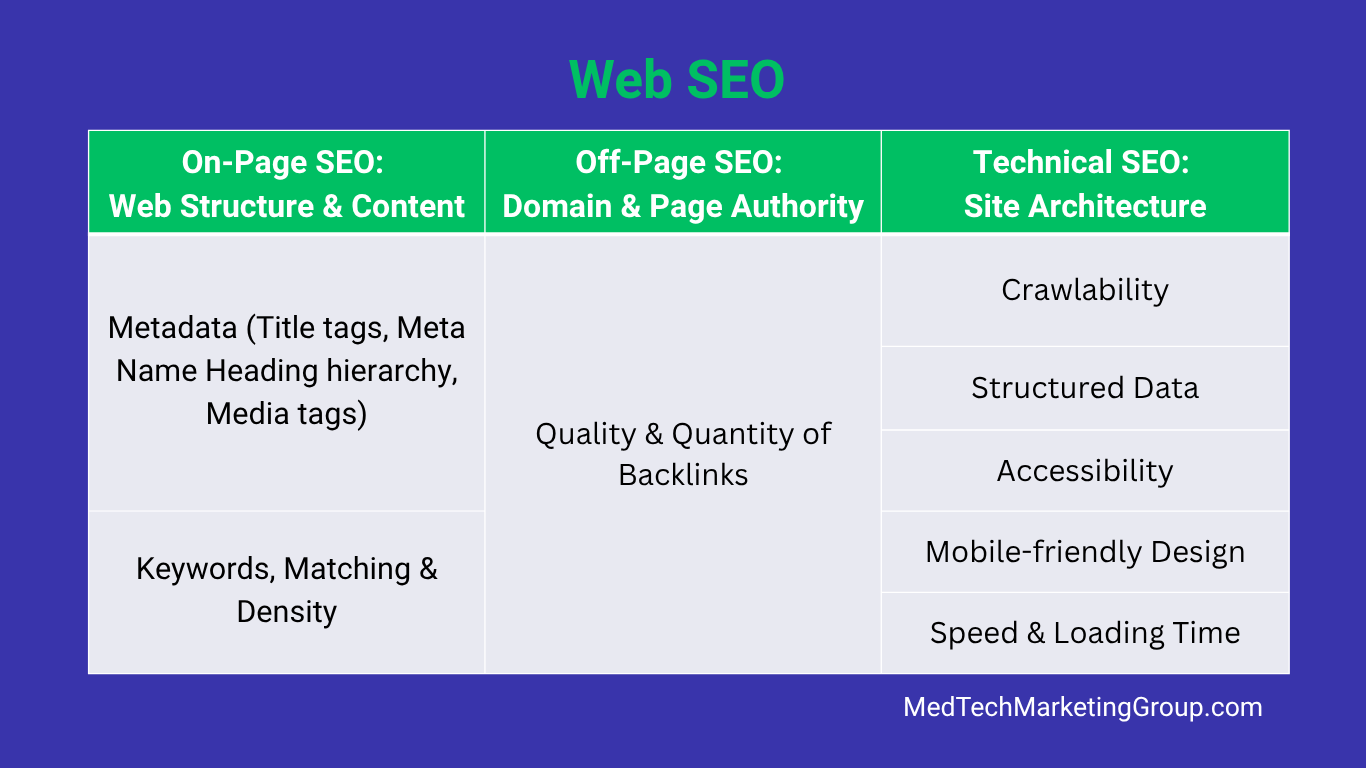
Components of Web SEO
How do I know if my website is not SEO optimized?
There are many indicators. Here are a few signs:
Your website isn’t SEO optimized is if it doesn’t show on the first page of search results or doesn’t show up in search results at all (this is very common for landing pages (standalone pages that aren’t part of a domain with a strong authority), sterile webpages (webpages that resemble “a business card” —they only display information).
Your website has a very low organic traffic, i.e. your page isn’t being discovered.
Your website has a very short copy with mostly graphics (which may not have alt txt tags,) so search engines can’t “read” them, and therefore don’t know how to index them in order to display to the right customer.
Typically, a marketing team within your company should have the right expertise to address website SEO. If you don’t have an in-house marketing team, there are marketing agencies who do that. But you don’t have to go far—we at MedTech Marketing Group, are happy to help you audit your website to improve its ranking in SERP. We have a proven method to uncover what components are missing, and provide recommendations and solutions.
Your website doesn’t show up in Google search results? Request expert help.
When do I need to optimize my webpage for SEO?
The moment you know you need to build a new webpage and definitely before you launch your product, you need to optimize your webpage for SEO. If you are a Product Manager or a Marketing Manager, this means that as soon as you built the product /in-service deck, finalized claims and key messages with regulatory, you are ready to bring the marketing team to build the website (write the copy and produce the assets).
If you are a Marketing Manager in MedTech, you need to partner closely with your product team and inform them in advance of website development process that includes all of the SEO components (many tend to focus on content only and forget other aspects). Plus, SEO is not something a Product Manager will think about because that’s outside of their scope of expertise.
Good to know: SEO is something you work on continuously, so even after you launch your website, you need to keep the content fresh and updated, revise copy and add new information, add more links, etc.
How long does it take to improve website SEO?
To improve website’s SEO, first begin by doing the SEO audit so you know what you need to improve. While the audit of a single product website in itself isn’t time-consuming, it’s the implementation of findings where most companies struggle and don’t complete because of the constantly competing priorities or lack of resources to do so.
Final takeaway:
Your website is your content hub, meaning all of your marketing promotion (either organic or paid) leads your target audience to your website. And if you don’t prioritize the quality of your website, don’t expect that customer will find it and fill out a form to request a rep or a product demo.
