

Overcoming the Three Big Barriers to MedTech Marketing Success
Article Summary
The Problem: Traditionally sales-driven MedTech organizations struggle to achieve commercial marketing success because legacy sales models fail to connect, capture and scale with the customer inn the modern digital market.
The Solution: Commercial teams must break through institutional barriers by updating corporate digital marketing expertise, centralizing legacy commercial intelligence inside automated CRM workflows, and building repeatable, scalable marketing architectures.
The MedTech Reality: Executive leadership teams (VPs and SVPs) are historically staffed by individuals from field sales backgrounds which creates a leadership blindspot within digital marketing expertise. Because the medical device sales cycle can take years, leaders often kill digital budgets due to a lack of immediate, direct-click attribution.
The Takeaway: Legacy sales models are no longer enough to win the modern market. MedTech companies must transition from slow, manual processes to scalable digital frameworks that keep the brand visible and consistently attract new customers.
Medical Devices companies, which are a part of the broader MedTech (medical technology) industry, are considered among the most innovative and dynamic sector of healthcare, yet many are still struggling with achieving a full marketing success in the HCP space (healthcare professionals). Let’s review what are the biggest barriers and how to overcome them.
Barrier 1: Lack of Digital Marketing Expertise
Traditionally, medical device companies are sales-driven organizations, i.e. they rely on sales rep (further “Sales”) to drive revenue. It’s a proven model that works—Sales get rigorous training, visit accounts to meet with prospective clients and use a variety of techniques to sell their products. They develop relationships overs the years with their physicians or other hospital staff, and if/when they move on to another company, they will continue to successfully sell their products.
The Core Product Management Function in Medical Devices
In medical device, a Product Manager (PM) plays a big role. They are true product experts. They know every nook and cranny of their device—exactly how each feature helps a physician use the product for maximum benefit to both them and the patient. They know the competitive landscape inside out and exactly how to counter a rival product. They also have a very close relationship with Sales, supporting them with a mountain of materials: print collateral, slide decks, and one-pagers. Yet, they almost always lack digital marketing expertise because technically, that’s beyond the scope of this role (consider that Digital Marketing Specialist/Manager is a whole new role in itself).
However, in today’s competitive environment, it will be very beneficial for a PM to have at least an understanding of digital marketing & strategy because marketing is not longer done via brochures and Sales.
What about Digital Marketing team to support product promotion? Not every organization has one; not every product team collaborates with their marketing team; and not every digital marketer is properly trained on product like the PM.
Case in Point: The Brochure-Only Launch
Imagine a scenario where a Product Manager launches a new device without a landing page or any social media activity—organic or paid. Instead, they rely entirely on Sales to handle the launch by hand-delivering freshly printed brochures to their current accounts.
Think about that for a second.
What about all the potential customers who don’t use your product yet? What about the surgeon who does their own research online before ever meeting a rep? With this 'offline-only' strategy, you are leaving money on the table. You’re ignoring the customers you aren't reaching—but you can bet your competitor is.
The Executive Blind Spot: Lack of Digital Expertise in Leadership
In MedTech, leadership roles (VPs and SVPs) are almost always filled by people with a strong sales and commercial background. While that’s great for the bottom line, it creates a skill gap: these leaders often have no hands-on expertise in digital marketing.
“How does digital help me sell?” - is a frequent response when asked about the role of digital marketing.
The obvious reason why this question is asked is because the sales-driven model works and it has proven results, i.e. at the end of the day you know how many products are sold and how much revenue it brought. With digital marketing, it is not so straightforward. There’s not tangible outcome to report at the end of the day or after your ads have stopped running. Customer life cycle (from the time they seen the ad to the time their hospital purchased the device) can take a few years, AND, you may most likely will not be able to attribute that sale to any of your digital activity. However, digital marketing allows you to be accessible to your customer 24/7 at their convenience, when you reps is not around.
When you reach the VP level, you have undoubtedly proven your skills. You know how to drive revenue and are likely very good at what you do. However, the MedTech industry is highly innovative and dynamic. To stay successful, you have to keep developing a skillset that doesn't just meet today’s market but prepares your organization for tomorrow. If you lack digital marketing expertise as a leader, it’s an easy fix: take an online course or ask your Head of Digital for a deep-dive overview. Of course, that requires the humility to admit what you don’t know—which is exactly what sets true leaders apart.
The Operational Consequence: Restricting Budgets
Lack of understanding often prompts leaders to fight digital marketing budgets. When those budgets get cut, we end up right back where we started: failing to reach new customers.
Case in Point: The X (Twitter) Evolution
Imagine this scenario: a new social media platform emerges, and you recognize it as a powerful tool to help Sales connect with their target audience. You suggest it to the VP of Sales. An executive without digital expertise will likely shut the idea down because they don’t see a direct, immediate pathway to revenue.
Take Twitter (now X) as an example. Around 2018, it gained popularity within the medical community. It provided a window into the daily lives, pain points, and needs of HCPs. Companies that recognized this trend early had an advantage by establishing thought leadership and engaging with their audience 24/7.
Today, advertising on X is a standard part of the digital plan for many MedTech brands. But those who failed to act early missed out on years of building critical relationships.
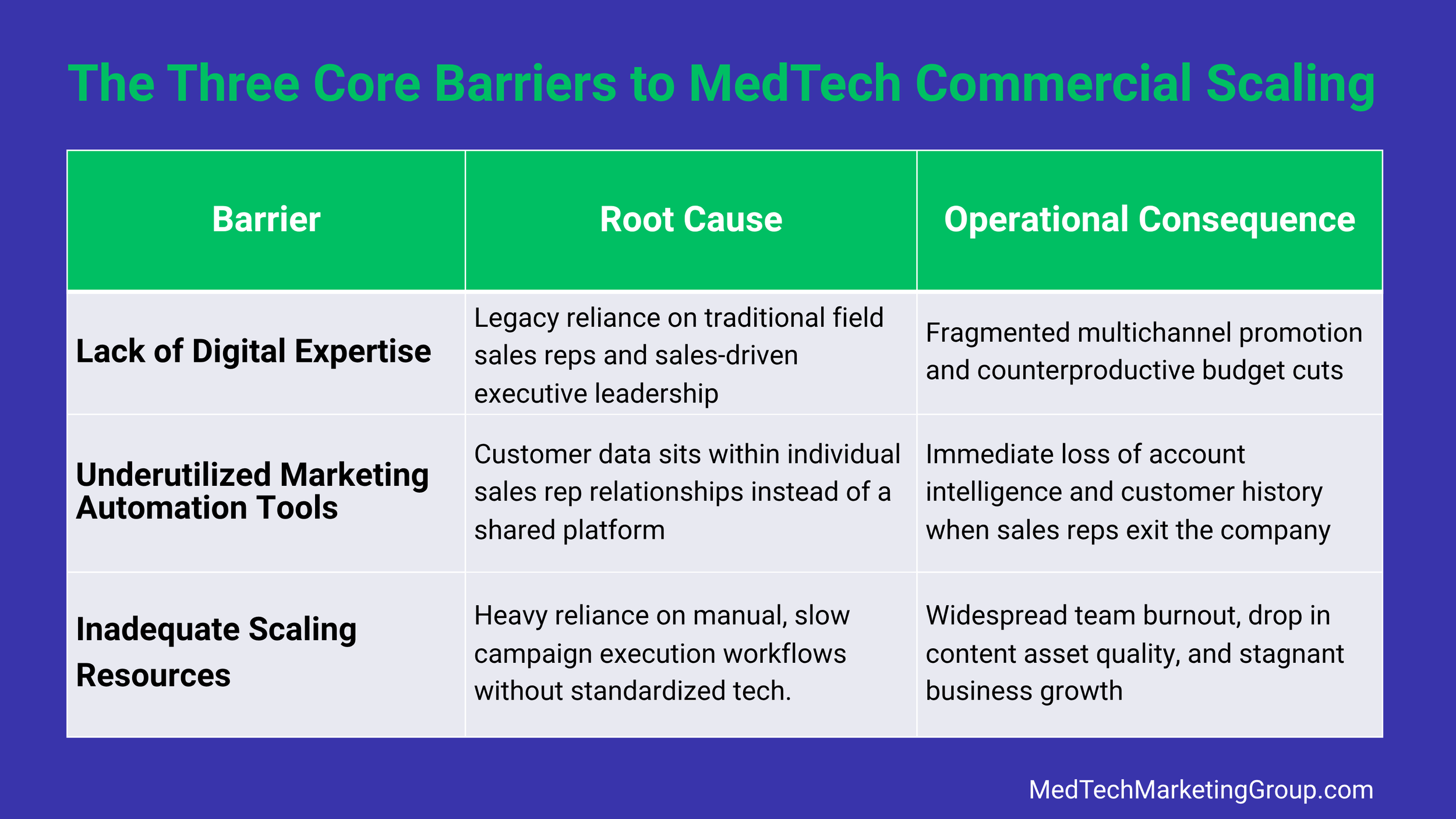
[+] Expand Data Table: The Three Core Barriers to MedTech Commercial Scaling
| Identified Institutional Barrier | Root Cause in Commercial Teams | Downstream Operational Consequence |
|---|---|---|
| Lack of Digital Expertise | Legacy reliance on traditional field sales reps and sales-driven executive leadership. | Fragmented multichannel promotion and counterproductive budget cuts. |
| Underutilized Automation | Customer data trapped entirely within individual sales rep relationships instead of a shared platform. | Immediate loss of account intelligence and customer history when sales reps exit the company. |
| Inadequate Scaling Resources | Heavy reliance on manual, slow campaign execution workflows without standardized tech. | Widespread team burnout, drop in content asset quality, and stagnant business growth. |
Stop guessing and start leading the digital conversation. If you’re ready to bridge the gap between traditional sales and modern digital execution, get in touch.
Barrier 2: Underutilization of Marketing Automation Tools
Let’s go back to the first point again - medical device companies are traditionally sales-driven organizations. Sales team members are the primary source of all customer information—they know everything about their customer (interactions, pain points, purchases, their personal info, etc.)—all that info enables them to effectively manage and sell. What happens when the reps leave the company? They take that info with them, the relationship they have developed with their customer, and the organization is left figuring out the details, and starts over with its effort to win this customer.
What if all of this information was stored in a central place accessible to any person, even after your rep has left the company? Any person (deemed necessary) could access this information to understand key info about the customer in order to keep selling successfully. In marketing terms, all this info allows us to understand the stage of the customer journey—a journey a customer takes from learning about your product to purchasing your product.
CRM: The Missing Link in Your Growth Strategy
Imagine now that this product already exists and it’s called CRM, or customer relationship management system. CRM’s function is to centralize customer information like contact details, purchase history, and communication logs, providing a single view of each customer across different departments within a company. This is not just tracking customer info, CRM provides commercial intelligence needed to optimize the entire sales funnel. It allows leadership to scale operations and drive higher ROI through precision-targeted campaigns.
CRM is just one example of the many marketing automation tools available today. These tools exist to streamline functions across marketing. The fewer tools you have, the more manual, time-consuming, and inefficient your operations become.
The Operational Consequence: Manual Process Failure and Stagnant Revenue
You won't reach your business goals. And if you aren't hitting those goals, you can’t sustain your business in the long term.
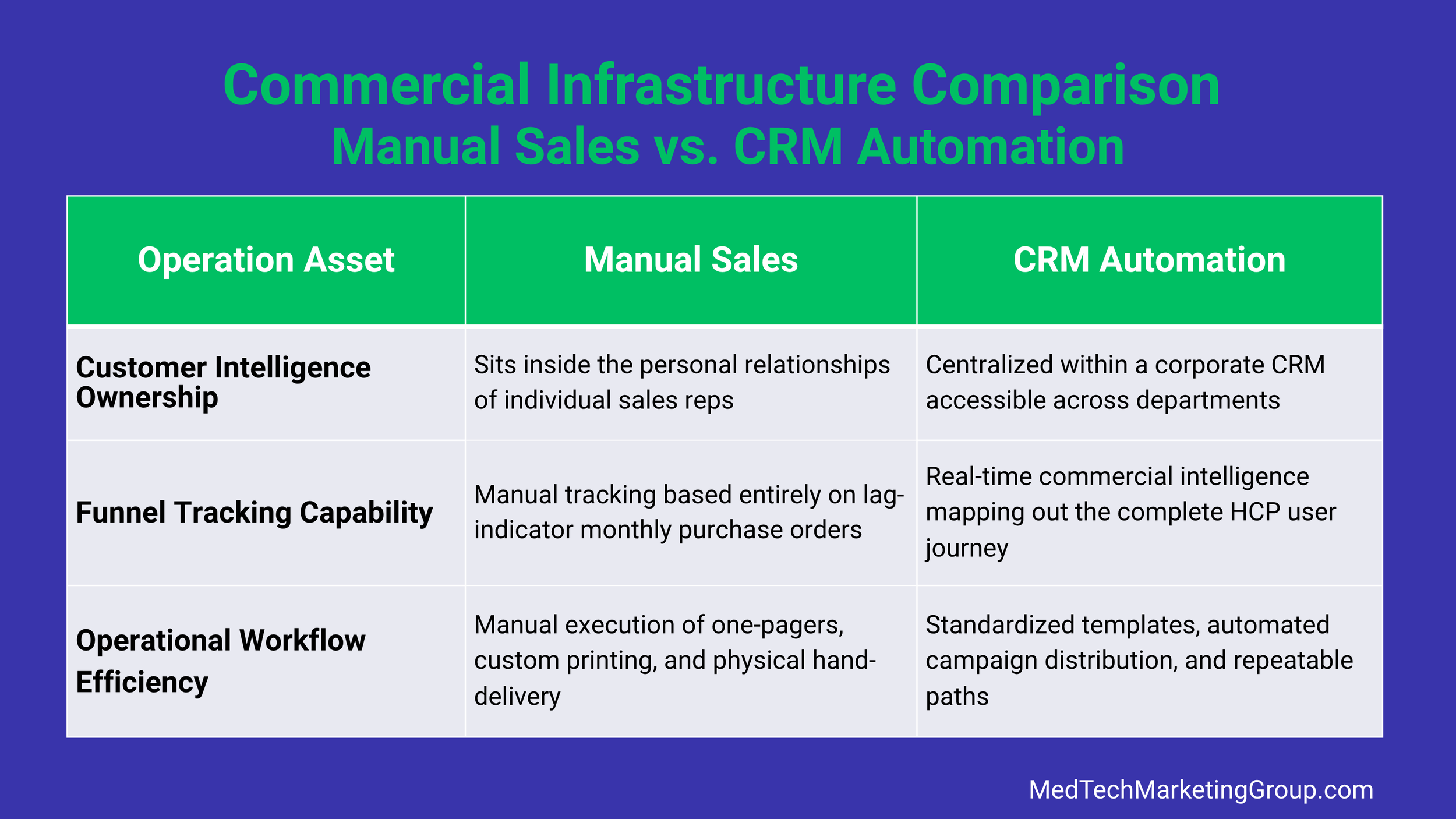
[+] Expand Data Table: Commercial Infrastructure Comparison (Manual Sales vs. CRM Automation)
| Operational Asset Vector | Legacy Sales-Driven Model | Modern CRM & Marketing Automation Model |
|---|---|---|
| Customer Intelligence Ownership | Trapped inside the personal relationships of individual sales reps. | Centralized within a corporate CRM accessible across departments. |
| Funnel Tracking Capability | Manual tracking based entirely on lag-indicator monthly purchase orders. | Real-time commercial intelligence mapping out the complete HCP user journey. |
| Operational Workflow Efficiency | Manual execution of one-pagers, custom printing, and physical hand-delivery. | Standardized templates, automated campaign distribution, and repeatable paths. |
Master the big picture. Take the Digital Marketing Strategy Course to help your team grow.
Barrier 3: Inadequate Capabilities and Resources to Scale Marketing Operations
Lack of automation tools is a precursor to inability to scale your marketing operations. Let’s face it: if you are doing everything manually, it’s not sustainable. The larger your product portfolio, the more pressing is your need to invest into the right capabilities to support your business.
Manual processes for tasks like campaign management, lead nurturing, and data analysis are insane time-sinks.
Teams working on too many priorities at once without enough resources—whether that's budget, staff, agency support, or the right tech — will experience reduced productivity, inefficiencies and even burnout.
Not every person you hire is an expert. An unskilled hire will spend more time working on a project, will make more errors and have to repeat tasks. If only one person on the team knows how to do their job/role really well (a true expert), that’s not scalable. You need to create repeatable marketing workflows and standardized templates that can be easily replicated to ensure consistency and efficiency as you grow.
Case in Point: When Growth Outpaces Your Infrastructure
Imagine your company is selling only one product and your have right-sized marketing team to support content creation, social media, email marketing and measuring data analytics. Your product sales are growing, you decide to hire another 1-2 people on your team to help “scale.” You can do that for a while. You gain more success and realize more revenue, you increase your marketing budget to millions. Scaling your promotion across more publications means your content needs skyrocket. You have to produce more assets, manage more data, and analyze every metric to ensure you’re still investing in the right channels. You’re expected to turn everything around with the same speed and efficiency as before, but without the right tools and capabilities in place, it’s impossible. Your teams are burned out because they’re handling double or triple the volume. As a result, the quality drops, and you start seeing poorer results. The dilemma here isn't that marketing 'isn't working'—it’s that your marketing isn’t scalable.
The Operational Consequence: Professional Burnout and Resource Slashes
Who is responsible for implementing these tools and capabilities? It falls on the expert marketing leader—whether that’s a Marketing Director, a VP, or someone in the C-suite. But what happens if that leader lacks digital expertise? Instead of investing in the systems that allow a team to scale, they cut staff and slash marketing budgets. And we are right back at square one: see Point #1 above.
Final Takeaway:
At the heart of every successful marketing promotion is a solid marketing strategy. Think of your strategy as the map—it tells you exactly where you’re going and how to reach your customer. When everyone on your marketing and product teams understands how to build that strategy correctly—and knows exactly what they are responsible for—they gain clarity on the tools, resources, and capabilities they need to succeed. More importantly, they can advocate for the right tools and systems within the organization, even if leadership is out of the loop. But if your team only understands the 'fragments' they are responsible for, they can’t help you scale.
Master the big picture. Take the Digital Marketing Strategy Course to help you and your team grow.
Does your organization need help? Get in touch.
