Campaigns vs Always-On Marketing: Which One is Best for Growth?
Article Summary
The Problem: Many MedTech marketers treat launch promotion like a single sprint—pouring their entire budget into a massive product launch campaign and then no doing any marketing activity for the rest of the year.
The Solution: Scale your product by building a balanced strategy that integrates high-impact, time-bound Marketing Campaigns with a continuous stream of baseline Always-On Marketing.
The MedTech Reality: Because medical device sales cycles are exceptionally long, stopping your marketing between launches leaves a big gap. While your brand is invisible, your competitors are actively swooping in to grab your customers' attention.
The Takeaway: Campaigns drive short-term outcomes and market growth, while always-on marketing maintains your market position. To build a high-ROI digital marketing engine, you must execute both side-by-side.
Shifting from launches to consistent growth
Many med device marketers approach their strategy like a sprint: massive all-out effort for a single product launch, and then nothing for the rest of the year. Marketing is not a sprint, it’s a complex process balancing high-impact campaigns and the 'always-on' marketing. The question is: which one is best for growth? Let’s review.
What is a marketing campaign?
A marketing campaign is a set of marketing activities designed to achieve a business objective over a specified time frame. The most common type of campaign in medical device is an awareness campaign for a product launch which has a clear start (typically, FDA-approval marks the start of promotion) and an end (i.e., when paid media coverage stops).
The three primary types of marketing campaigns
Awareness Campaigns
An awareness campaign is designed to inform (=raise awareness) your target audience about new product/therapy or clinical data to gain mind share.
Primary Goal: To reach the maximum number of relevant target audience (relevant = quality) over a set period of time with a repeated message
Channels: Typically a multi-channel mix that includes channels that your TA consumes info on, i.e. relevant display, print, social media, etc.
Targeting: broad
Engagement Campaigns
An engagement campaign isdesigned to actively nurture (engage) users who are aware of your product to deepen interest and consideration
Primary Goal: To move engaged users towards conversion in the marketing funnel, i.e. towards the purchase of your product
Channels: Best for Email Nurture Campaign
Targeting: narrow (highly targeted to specific users)
In medical device marketing, a typical engagement campaign is your Marketo (or another brand of a marketing automation software) email series campaign that you send to HCPs who are aware of your product, but not using it yet. Through this curated email series, you are trying to convince them to purchase your product.
Note: this is not the same as sending eblasts.
Lead Generation Campaigns
A lead generation campaign is designed to obtain a user’s contact info (prospects, or prospective customers) through a filled form for a specific product or portfolio
Primary Objective: To build internal database of prospects for future marketing, i.e. email nurturing
Channels: relevant organic and paid social, webinars or virtual events, medical congresses, etc.
Targeting: narrow
This is an underutilized campaign in medical device marketing in part because majority of the marketing budget and resources are dedicated to product launches, and the rest (if any left) - “all other” marketing.

[+] Expand Data Table: Core MedTech Campaign Types Compared
| Campaign Strategy | Primary Marketing Objective | Optimal Channels Used | Audience Targeting Scope |
|---|---|---|---|
| Awareness Campaign | Maximize relevant mindshare and introduce new product clinical data. | Display ads, medical print, organic social networks. | Broad / Category-wide |
| Engagement Campaign | Deepen product consideration and nurture warm prospects down the funnel. | Curated automated email series (e.g., Marketo workflows). | Narrow / Highly targeted |
| Lead Generation | Capture verified contact data through high-value content gates. | Webinars, virtual congress events, landing page forms. | Narrow / ICP Segmented |
Five key parameters that define a marketing campaign
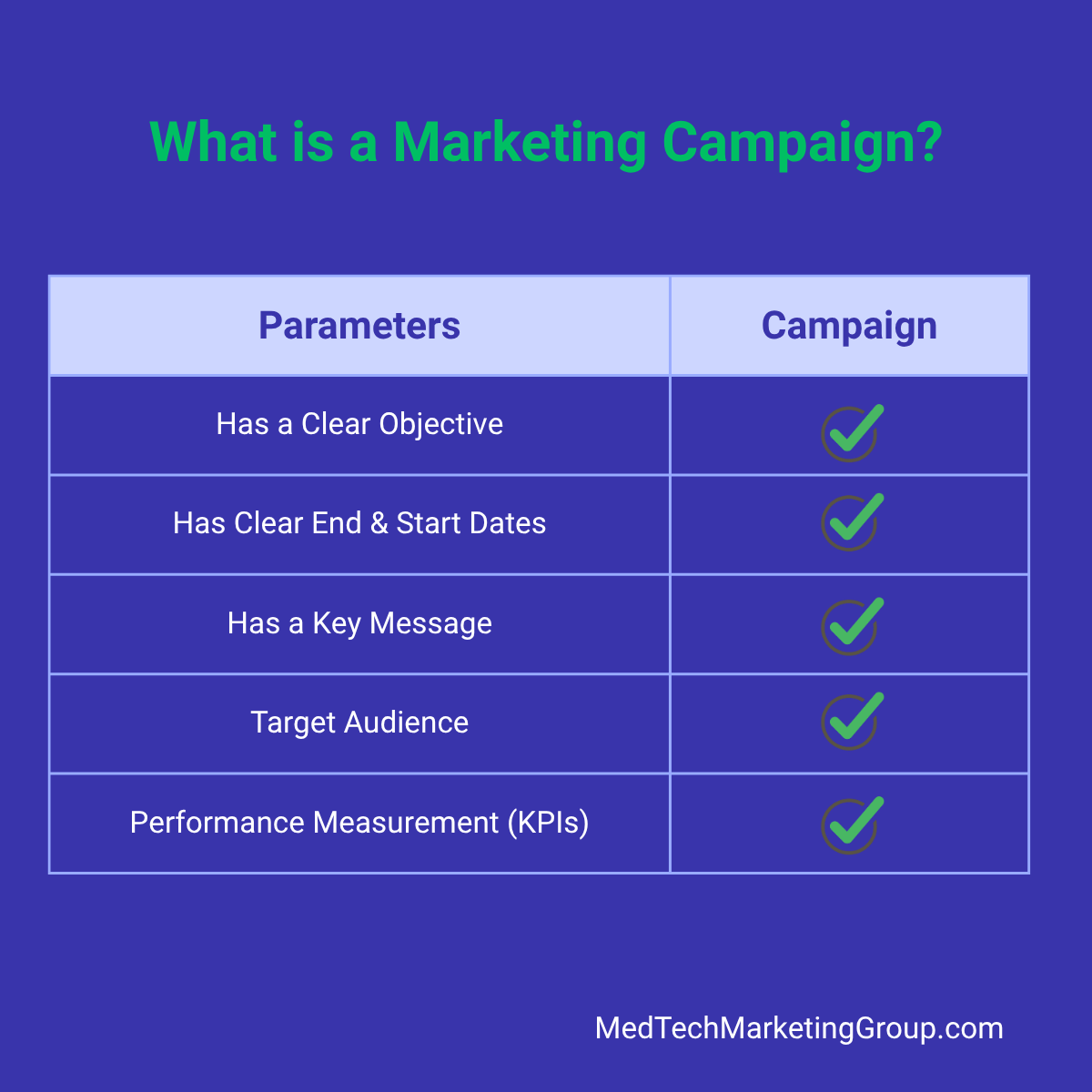
Supports a clear business goal
For example, if your business goal is to drive product adoption, you will run a variety of campaign aimed at achieving this goal (can be a combination of awareness + engagement campaign)
Has clear start and end dates [time bound]
To achieve your business objective, your campaign needs to run for a specified timeframe. Duration varies from weeks to months. Not every campaign will run the same length.
Has a key (central) message or a theme
The key message is communicated via every channel used in the campaign. For example, Product X is now FDA approved. This message will be shared on social, display, print, etc. but adapted to each channels parameters. For social media posts, you may have multiple creatives.
Targeting
You are targeting specific audience or audience segment with your message.
Performance is measured (KPIs)
Performance is measured against metrics, knowns as Key Performance Indicators (KPIs) to evaluate campaign performance.
[+] Expand Data Table: Strategic Differences (Campaigns vs. Always-On)
| Strategic Attribute | Time-Bound Marketing Campaigns | Consistent Always-On Marketing |
|---|---|---|
| Core Business Purpose | Drives aggressive market growth and specific outcome-based ROI. | Maintains brand position, market continuity, and visibility. |
| Time Frame Execution | Strictly bound by clear start and end dates (weeks to months). | Ongoing, evergreen deployment across the entire calendar year. |
| Messaging Architecture | Centralized around a single unified product theme or clinical claim. | Distributed variety of independent topics (events, case studies, promos). |
| Platform Algorithm Impact | High short-term ad network exposure and spike volume. | Fosters long-term platform organic reward via posting consistency. |
What are the benefits of marketing campaign?
Because campaigns are strategically designed to drive a specific outcome and are measured, they offer insight into customer engagement and behavior—what resonates, where engagement is strongest, and what drives users from interest to conversion (and ideally to sales follow-up). This enables smarter channel selection, more efficient budget allocation, and better use of resources to achieve business goals.
Key Takeaway: You run a marketing campaign to drive a specific outcome.
Tired of wasting budget on strategies that don’t deliver? Take the Digital Marketing Strategy Course and learn how to build a proven strategy that delivers results.
What is Always-On Marketing?
Always-on marketing, also known as “ongoing marketing” or “evergreen marketing,” includes all other marketing promotion that doesn’t meet parameters of a campaign. For example:
Social media posts that share different types of information about your product, but are not necessarily connected by a key message (webinar promo, specific event promo, case report, new product video from a symposium, etc.)
A print ad that runs for a few issues
Occasional eblast to communicate any product-related info
What are the goals of Always-on Marketing?
The main objective with Always-on marketing activity is to maintain your brand (product) presence and continuity. It helps to keep your product top-of-mind for your target audience in a highly competitive environment. Continuous engagement is especially important on social media platforms as algorithms favor consistent posting.
There’s an incremental value but not always easily quantifiable as a campaign. It plays a “an invisible role,” like display ads – they are there, but because you aren’t getting quantifiable analytics, you can’t fully determined their impact.
Always-on marketing is frequently overlooked or de-prioritized in medical device marketing because majority of marketing resources go to that one massive all-out effort, typically a product launch or clinical data launch, if significant. Plus, marketers are stretched too thin, and simply don’t have the capacity to support more content production.
Key takeaway:
With always-on marketing, you aren’t driving a specific outcome, you are maintaining your position [in the market] and that alone is not enough to drive product adoption or any desired outcome.
Final takeaway
Both are important, and because they serve different purposes, they best work together to support a comprehensive marketing strategy.
Campaigns drive outcomes and growth, always-on marketing maintains your position.