

Article Summary:
The Problem: Building a new product website is a huge task that consumes a lot of resources: time, budget and people. Too save those resources, Product Managers shortcut the process by flipping a product brochure into a website.
The MedTech Reality: In medical devices, cutting corners on web structure creates commercial and legal risk. Rigid brochure layouts frustrate HCPs scanning on their phones, while poor formatting exposes your site to accessibility lawsuits.
The Solution: Treat your brochure as a source of info, not a layout template. Pull the core messaging and clinical data out of the PDF, then rebuild it into responsive, modular web components designed for mobile screens, search engines, and assistive tools.
The Key Takeaway: Your website is an active commercial portal, not interactive paper. Keep your regulatory-approved brochure as the source of truth for clinical facts, but modularize that content into an accessible, scannable web layout that ranks on Google and converts HCPs.
As a Product Marketer in MedTech or medical device, how often have you thought of taking your printed product brochure and flipping it into a webpage? While this is a common approach – especially in start-ups or small scale companies -- it is not the right approach, and it can can backfire. In this article, I review 5 reasons why copying a print brochure hurts your website and what to do instead.
Print Layout Principles Don’t Translate into a Digital Environment
A brochure is a linear document designed for passive reading. A website serves as an interactive, self-service tool that guides a user from the initial discovery of your product to deeper understanding of your product implementing a variety of formats (videos, audio, quizzes, ePDFs) designed to drive a digital conversion (when a customer fills out a contact form).
So if you are doing a direct copy-paste approach, it will break user experience, search indexing, and lead generation.
Visual Flow: Z-Pattern vs. F-Pattern for Content Consumption
People read printed and digital materials differently
The Brochure Layout (Z-Pattern): When we design a marketing brochure, we treat each page as its own visual piece, and we design them for a Z-pattern consumption, i.e. where a user scans the copy from the top left, to the top right, and then down diagonally to the bottom left and then right.
The Web Layout (F-Pattern): Website users do not read pages line-by-line; they scan them. When we design webpages, we design them in the F pattern. Users read the main headline, sub-headline, and then scan vertically down looking for bold text, bullet points, etc.
When you copy multi-paragraph print blocks onto a webpage, you disrupt the natural scanning flow. As a result, a user gets fatigued or not interested, and leaves the website. On the backend in Google Analytics, you see that as high bounce rate.
Side Note about Bounce Rate
GA4 doesn’t use Bounce Rate in its standard reporting. Instead it uses Engaged Session. Engaged session is considered when any of these three criteria are met:
User stay on site for at least 10 seconds
View 2 or more pages
Trigger at least one key event/digital conversion.
If a user fails all three, it means a “bounce”
Tip: If you prefer looking at percentages, you can manually restore the Bounce Rate column. Go to Reports > Engagement > Pages & Screens, click the pencil icon to customize the layout, select Metrics, add Bounce Rate, and click save.
The Marketing Funnel Mismatch
A brochure and a website serve entirely different stages of the customer marketing funnel (a pathway that shows a journey a user takes from discovering your product to purchasing your product)
A printed or digital brochure is almost always produced for mid-funnel journey, i.e. when a customer already knows about your product, but you are trying to feed them more information (clinical data, testimonials, cases studies) to buy your medical device for use in a hospital or clinical setting.
Your website, however, must capture the entire funnel.
The content on your website must connect with users across entire funnel – those who just landed on your page from the ad they saw on LinkedIn, but never heard about your product, to those who are familiar, but looking for a deeper evidence of why your product can help their patients, and to those who are looking for order specs.
Your website should tell a comprehensive captivating product story and convince HCPs to use it.
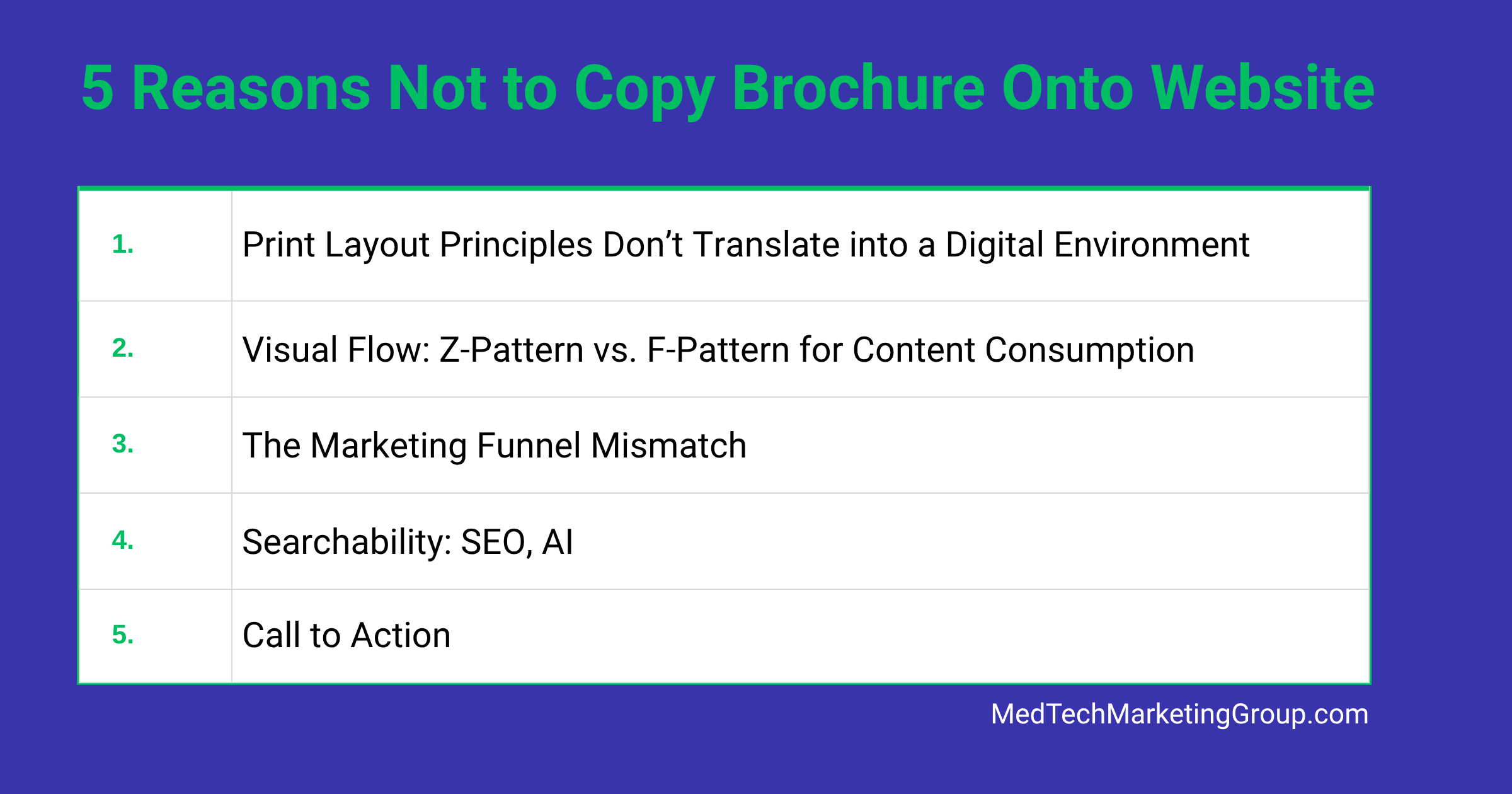
Searchability: SEO, AI
A printed brochure (and yes, even your digital PDF brochure!) does not need to rank on Google. It is handed over directly by a sales rep or attached to an email. Because it doesn't need to satisfy search engine algorithm, brochure copywriting focuses almost entirely on product features, spec, and large visual and charts.
A website operates under a different rules.
The SEO or AIO
To win organic search traffic, web content must actively answer the specific clinical questions physicians are typing into search bars. Google rewards content that demonstrates deep authority, real-world expertise, and trust (E-E-A-T framework). Paragraph blocks copied from a brochure don’t possess the depth and bread of content and the structures needed to rank.
Search engine’s AI algorithm look for highly structured, descriptive text to synthesize answers for users. If your website only contains surface-level brochure fragments or hides its important insights inside an un-scannable PDF, AI engines will ignore your site and not pull it into answer summaries. They will pull your competitors’ descriptive web pages into their search summaries and citations instead.
Website Typography vs. Print Typography
Digital brochures (like downloadable PDFs) use vector layouts designed to stay intact as a static page (I used to design brochures in Adobe InDesign and Illustrator early in my career.) Because of that, they can support custom brand fonts and wide text alignments. Web layouts must follow much stricter technical rules to keep text legible and prevent display rendering failures.
Sizing: Brochure typography is measured in Points (pt), while website text is measured in Pixels (px) or relative units (em/rem). If you force a print layout onto the web without translating these grids, the text renders incorrectly and looks blurry or pixelated. And I think we all can agree how annoying pixalated graphics are.
Line Width and Cognitive Load: A printed brochure can support wide columns of text because the physical page boundaries anchor the eye. On digital screens, long horizontal lines create a big cognitive load. When a line of text is too wide, it escapes the user’s peripheral vision. The reader loses their place, gets strained, and is forced to re-read the same paragraph.
The Typography Rule: To optimize text consumption on digital screens, website line lengths must be strictly contained to 60 to 75 characters per line.
Strict Digital Compliance and Accessibility Laws
In a highly regulated field like the medical device industry, digital accessibility is a legal mandate, not an optional design choice. In the United States, the Americans with Disabilities Act (ADA) requires website layouts to follow the Web Content Accessibility Guidelines (WCAG) to ensure content is usable for individuals with visual, hearing, or cognitive impairments.
Websites face rigid technical requirements that brochures do not:
Code Structure: Websites require strict structural formatting. Think of it like a formal document outline: your main title must be coded as a Title (H1), your subheaders as Heading 2 (H2), and your body copy as standard text. If you just copy-paste a brochure, the code looks like a flat block of unformatted text, and screen readers (software that reads text for people with visual impairments) can’t read it.
Media Accessibility: Images require descriptive Alt Text, and data charts or videos require screen-readable equivalents.
Font Scaling & Zoom Flexibility: Website text must use responsive, web-flexible fonts (like standard Google or Adobe web fonts). The code must allow a user to zoom in and increase the text size up to 200% on their screen without the words overlapping, getting clipped by boxes, or breaking the page layout.
Color Contrast: Web elements require strict background-to-text contrast ratios to remain legible.
Compliance Risk with PDF brochures
PDF brochures lack a proper text hierarchy, they can’t rearrange words in a proper way when a user zooms in on a phone (making readers scroll endlessly left and right), and can even crash mobile screen readers. Copying a printed layout onto a webpage duplicates these failures.
Specialized law firms actively audit medical device websites to find these compliance failures and file lawsuits (Yes, believe it or not, it’s a real thing!). So by following a brochure layout for your website, you are creating an immediate legal liability.
Call to Action
Printed brochure and website have different mechanics for the call to action (CTA), i.e. what your want the user to do after they are done reading info.
The Brochure: Usually has one bottom-of-funnel goal—to sell the product or request a rep meeting (and sometimes, CTAs are absent if brochures designed to be hand-delivered by a Sales Rep)
The Website: Built to drive micro-conversions along the user journey. It invites the user to read a clinical case study here, watch a mechanism-of-action (MoA) video there, and then download the full brochure once they are interested and ready to learn more.
If you turn your website into a digital brochure, you create an abrupt, dead-end user experience that fails to nurture prospects into buyers.
Final Takeaway:
A website is an active, self-service commercial portal—not interactive paper. While your brochure contains excellent, regulatory-approved clinical facts, copying its layout and text directly onto a webpage is a guaranteed way to drive up your bounce rates, alienate physicians, and fail accessibility laws.
Instead of copying the brochure, modularize it. Use the brochure as your legal source of truth for clinical data, but re-architect that data into a scannable, accessible, F-pattern web layout designed to rank on search engines and convert high-intent healthcare professionals.
